Creative Process

Spring Should Be Here Already

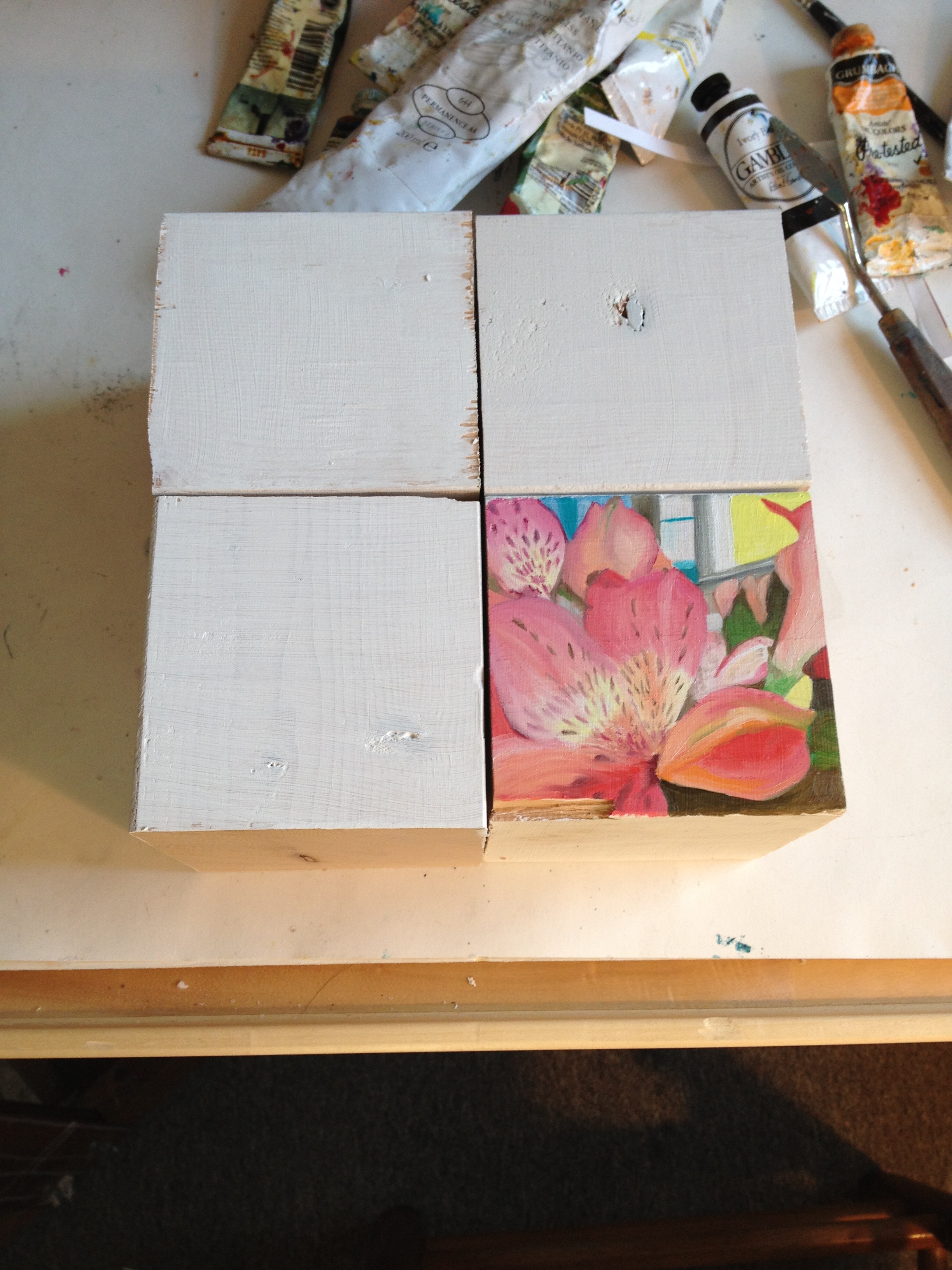
There are 29 of these blocks left in my studio...

There are 29 of these blocks left in my studio…

There are some things in the studio that are a beautiful metaphor for how our lives are really going.  My newest project sums up everything about my life as a yogi, a development professional, a wife, a mother, a person of faith.

Years ago, I painted a puzzle — it was eight smaller cubes that fit together to form a much bigger cube.  On the outside facades, I painted apples.  On the other facades of the individual cubes, there were aspects of a human face.  It sold in a show in Tennessee, and I was shocked.  I still miss it, like you miss an old friend.  I thought I would paint another one, but you start to understand the futility of this enterprise.  It is like saying, “I’ll have another child just like the one I just had.” It doesn’t happen.

So, when I started treating myself to a weekly bouquet of flowers, I thought — great idea for the facade of another puzzle piece!  My sweet hubby helped me pick out a beautiful piece of pine at Home Depot and waited as a patient wood-cutter split the beam into 33 pieces of 3.5 x 3.5 inch cubes.  They occupy a laundry basket in my studio.

The pics of these blossoms inspired me and the first painting of my first little cube came out pretty effortlessly in an afternoon.

Then life got in the way.  I subbed a lot of classes at the studio and I learned a lot, but didn’t paint at all. Then I  had a big event for work and didn’t spend any time painting. I wanted to make sure to spend time with the wonderful and giving hubby that would spend time with me in the Home Depot and is a wonderful friend and companion.  No painting — but lots of time with him. The second and the third facades were not as effortless.  The details of the flowers were not fun, they were painful — how many little lines are in those strange little green flowers?  How do you paint a flower that has petals like a cabbage, for God sakes? My back ached in the seat, I kept finding new distractions in the room…

The unpainted cubes mock me from the laundry basket. What was I thinking? Why is this project even remotely important?
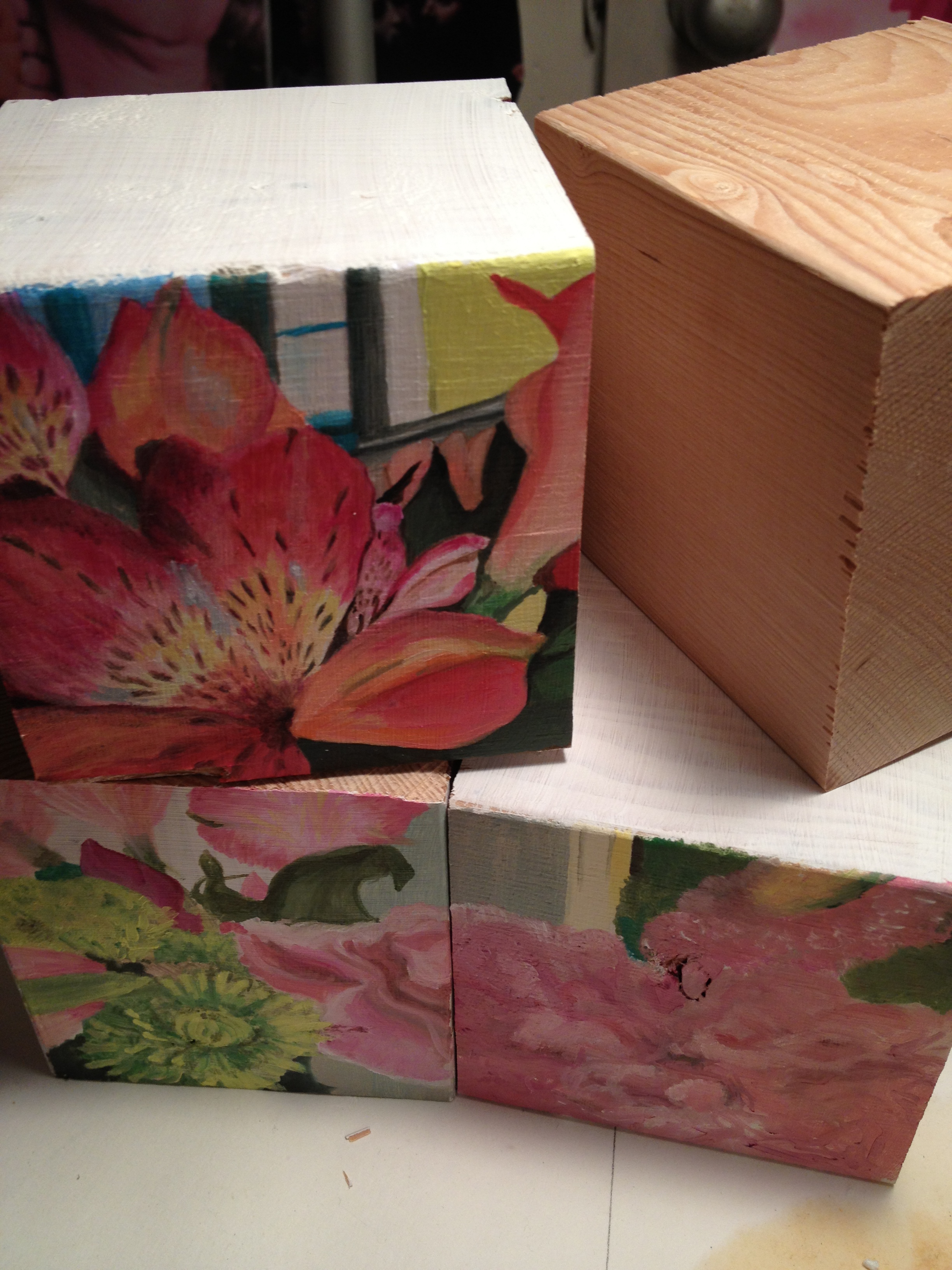
Now, still 29 blocks...

Now, still 29 blocks…

Even though I’ve lost my sense of purpose or process with this project, I  must get through these blocks.  I can’t have twenty-nine 3.5 inch cubes in our laundry basket any longer.

Spring needs to come soon, literally and figuratively.  As a meditative prayer, I’ll be painting lots and lots of very complicated flowers. And that’s the yogic/parenting/friendship/spiritual lesson.  Get on with it because we really, really need the laundry basket.  And spring.
Nothing Says Christmas Like Bees

Image

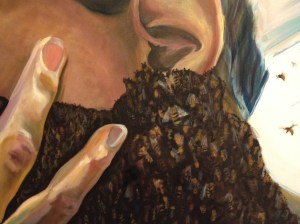
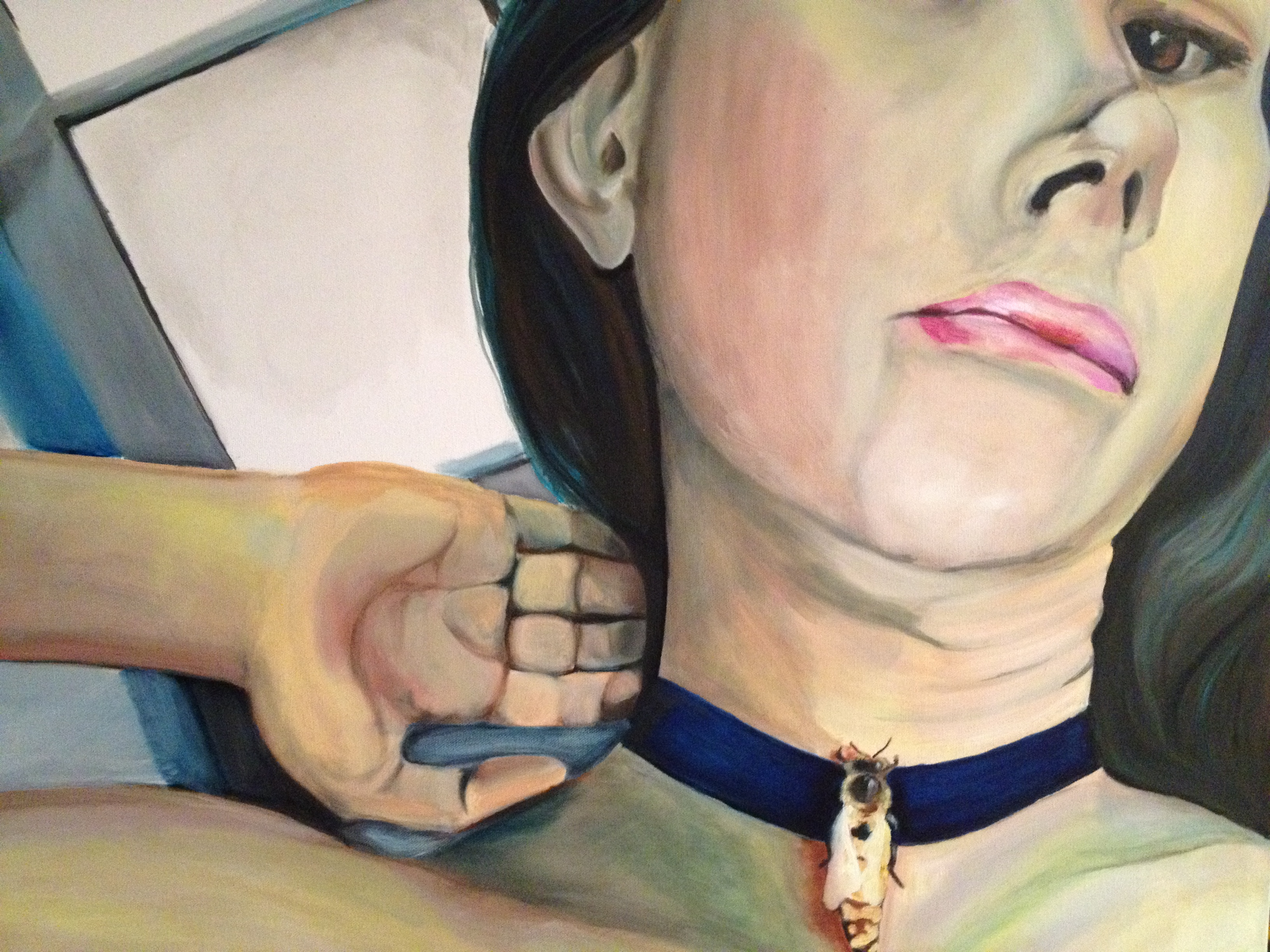
To make a bee beard, one starts with tying the queen to the neck.

For the longest time, I’ve been working on a “prequel” to my painting of a bee beard.  I got serious as my 49th birthday approached.  I found that I was industrious about the task — not getting stuck in old ways of over-thinking the concept, or of perfectionism about the line or form, or becoming bored by the tasks I had laid out for myself day by day.  I just got to work and when I was tired, I laid down the brush.  I was…well, like a bee. The result is here.

When I did let myself ruminate on bees and bee beards, I couldn’t remember why I wanted to paint them at all. I’m sure it originally related to the concept of apples and honey that I had painted as I worked through the Eve and the Garden series so long ago.  Just wanting to keep that alive.  The bee beard painted itself almost,  and remained an oddity — a question mark.  It needed a prequel. Here’s the painting of the bee beard:

bee beard

I looked up the meaning of the symbol of bees in the illustrated encyclopedia of traditional symbols and began to get a murky sign from the universe about why I had chosen the subject, and to my sensibilities they seem holiday oriented. The bee is a sign of immortality, rebirth, industry, order, purity and a soul.  In Christianity, the bee is a symbol Mary, mother of Jesus; in Hinduism, the bee on a lotus is the symbol of Vishnu.

The symbol of the ancient Greek goddess Demeter is the bee.  She is sometimes called the “pure Mother Bee,” and the Greeks worshipped her as the bringer of the harvest.  In ancient times to whisper something to a bee would bring the message to the spirit world.

The way these paintings came to me felt as though they were a whisper to me from a place of collective and universal consciousness.  I found joy in the process of painting them and then in thinking about what I had painted, rather than what I would paint.

Bees, I’m sure, don’t think about the honey either.  Hope I can carry this into the new year.

And now, a beautiful poem about bee beards given to me after she saw the strange bee beard painting by my dear friend and amazing poet and artist Marie Pavlicek-Werhli:

The Girl with Bees in Her Hair

BY ELEANOR WILNER

came in an envelope with no return address;
she was small, wore wrinkled dress of figured
cotton, full from neck to ankles, with a button
of bone at the throat, a collar of torn lace.
She was standing before a monumental house—
on the scale you see in certain English films:
urns, curved drives, stone lions, and an entrance far
too vast for any home. She was not of that place,
for she had a foreign look, and tangled black hair,
and an ikon, heavy and strange, dangling from
an oversize chain around her neck, that looked
as if some tall adult had taken it from his,
and hung it there as a charm to keep her safe
from a world of infinite harm that soon
would take him far from her, and leave her
standing, as she stood now—barefoot, gazing
without expression into distance, away
from the grandeur of that house, its gravel
walks and sculpted gardens. She carried a basket
full of flames, but whether fire or flowers
with crimson petals shading toward a central gold,
was hard to say—though certainly, it burned,
and the light within it had nowhere else
to go, and so fed on itself, intensified its red
and burning glow, the only color in the scene.
The rest was done in grays, light and shadow
as they played along her dress, across her face,
and through her midnight hair, lively with bees.
At first they seemed just errant bits of shade,
until the humming grew too loud to be denied
as the bees flew in and out, as if choreographed
in a country dance between the fields of sun
and the black tangle of her hair.
                                                   Without warning
a window on one of the upper floors flew open—
wind had caught the casement, a silken length
of curtain filled like a billowing sail—the bees
began to stream out from her hair, straight
to the single opening in the high facade. Inside,
a moment later—the sound of screams.
The girl—who had through all of this seemed
unconcerned and blank—all at once looked up.
She shook her head, her mane of hair freed
of its burden of bees, and walked away,
out of the picture frame, far beyond
the confines of the envelope that brought her
image here—here, where the days grow longer
now, the air begins to warm, dread grows to
fear among us, and the bees swarm.

Eleanor Rand Wilner, “The Girl with Bees in Her Hair” from The Girl with Bees in Her Hair. Copyright © 2004 by Eleanor Rand Wilner. Used by permission of Copper Canyon Press, www.coppercanyonpress.org.

Rose Hips and Rosy Hips

I don’t know where I learned that the hips are where we store all of our emotions. I know it to be true though. When I’ve had a deep hip opening practice I feel like a dam has burst, and a few times this has ended in cleansing tears, much to the consternation of my family. Nevertheless, I resist hip openers in my own practice and haven’t found a really good way to work deep hip openers like pigeon pose into the hour-long early morning practice that I teach at Tranquil Space. My friend Alyson reminded me how much people love them, and so today I settled the class into pigeon and found my own heart opening vicariously.

I’d guess that hips have been on my mind for a while now. My own hips and the struggle against spread now that I’m fully planted in my middle-aged years. My daughter’s hips as I’ve watched as they’ve grown from boyish to beautiful in the past five years. My father’s and brother’s hips now that they are successfully replaced with titanium. When I cue asanas in class I feel as though I keep harping on “squaring the hips,” and have to smile to think of my mentor’s comment about “honest hips” in yoga practice.

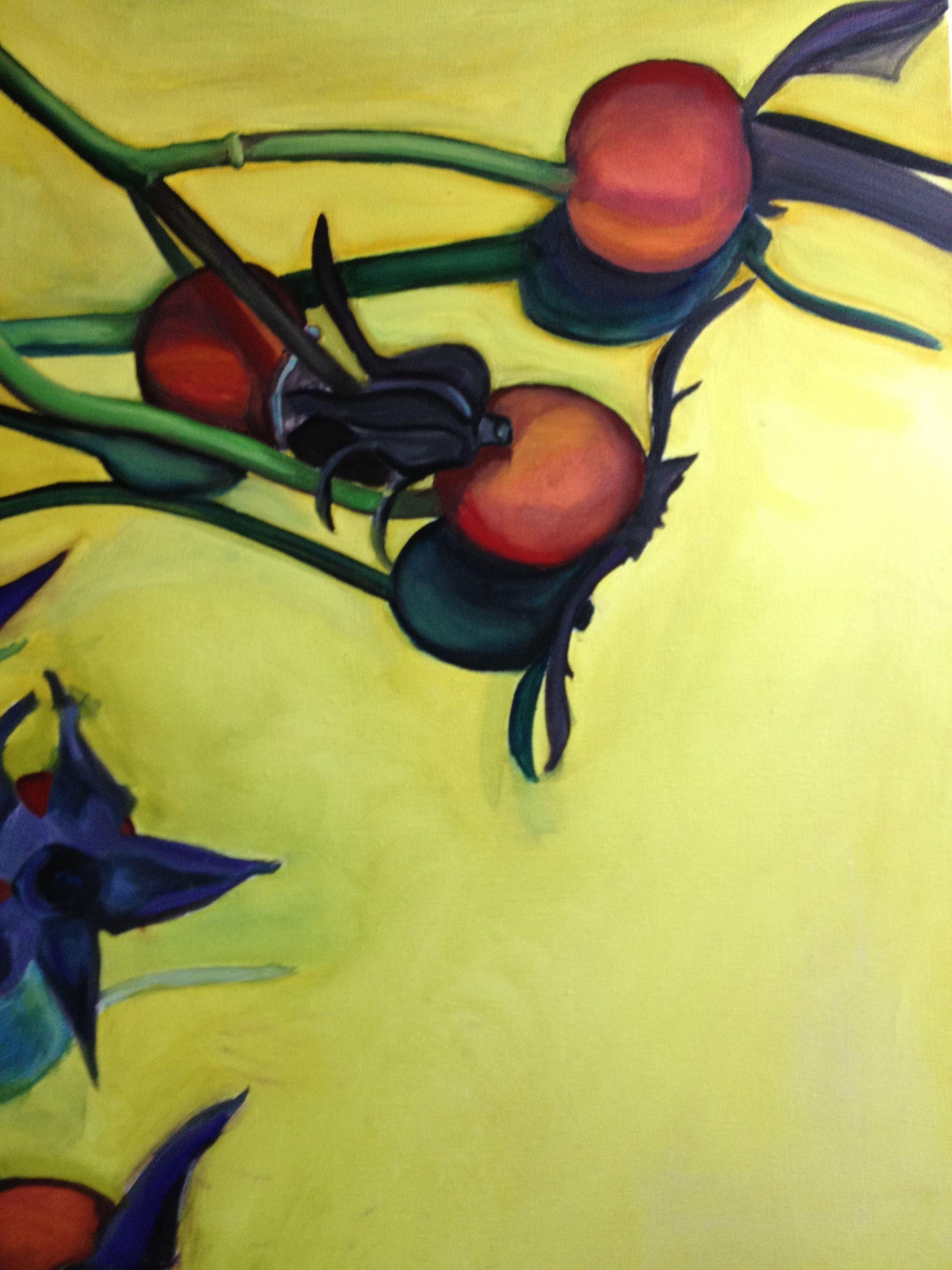
I’ve also been working on this painting of rose hips, which are unusual in our severely landscaped neighborhood. Tom and I are notoriously terrible gardeners — we like to say that we grow children, not plants. A rose bush that I planted in the front yard has grown amok — sometimes falling over, other times hastily nailed up to the house, most of the time annoying Tom as he mows the front yard. We love to see it on that one week of the year when it is gloriously in bloom, then don’t pay it a bit of attention until the next year. It is a canopy to the window well where I keep my easel, and so when a sweet little chipmunk showed up to gnaw on acorns in front of the window as I was waiting for inspiration, I paid attention to him and then to the rose bush, which was covered in rose hips.

Rose bushes that aren’t well groomed grow rose hips — a fruit which holds rose seeds. And like all things in nature that are left to a little chaos, the lack of control can lead to wonderful sustenance. You can clip rose hips and make tea with a few of them, and jam if you have buckets of them. They have huge amounts of vitamin C and anti-oxidants. Thinking of eating this fruit reminds me of childhood. I can remember as a child having rose water liberally sprinkled on food. Or the Chartreuse green of Rose’s Lime Juice in a glass of soda and raw sugar. (Perhaps this is where the green-yellow comes from in the background of this painting.)

The pose of the month at the studio is bakasana, crow pose. This powerful pose requires open hips and a fearless heart as you hoist yourself up on the upper arms, balancing on hands, almost kissing the ground. The fruit of this pose is an open heart — tapping into emotions buried deep in the hip. As Alanna Kaivalya explains in Myths of the Asanas:

There’s a striking contrast between the way humans hold on to fear and the way animals freely let go of it…Asanas give us the opportunity to do just the same. We get the chance to move our life experience through our bodies by taking the shapes of the various forms in nature. We stretch and create space in our joints and muscles and do our best to embody the essence of each posture, learning its inherent lessons and experiencing freedom in that form. When this process takes hold and begins to release the fear from our body and our heart, we are able to live our lives joyfully, moment to moment. Fear lives in us as tension, and asana postures are designed to release tension from our bodies. The absence of tension is the absence of fear. And the absence of fear signifies the presence of joy, love and open-heartedness. As we embody these shapes in nature, we learn to fall in love with the world around us.

Domestic Gods and Goddesses

Inspiration from an exhibition, a wedding and the great life indoors.

Yesterday a good friend married his long time partner in a sweet and loving ceremony in Georgetown.  As we walked to the reception at the university through the fall leaves and bright sunshine, we were both struck by how different our wedding was from theirs. This couple has been together for quite some time as domestic partners.  Their lives are already completely wound up in and around their wonderful families.  I loved it when the groom’s sister-in-law said in her toast, “I’d say welcome to the family, but you are already a big part of our family.”

Tom and I had only known each other for a short time when we decided to get married almost 25 years ago, and we really had never shared a domestic life before our wedding day.  Our first child was born ten months after our wedding, four months after we bought our first house.  After our first chaotic year together, we found a good way to bring some control into our lives:  We became domestic god and domestic goddess.  Even though we have always been 50/50 partners and we have both worked full-time, Tom had his realm and I had mine.  He does the lawn and the dishes and the laundry.  I cook and am in charge of the inside of the house and was the parent in charge during illness, upset and homework assignments.

The domestic arts have been a good place to be creative.  I have painted the dining room almost as many colors as Benjamin Moore makes.  I have planned kids birthdays and band bashes.  I have decorated each room with care, tried new recipes, taken the Christmas card photos, and served as the organizer of the PTA International Night Talent Show at the middle school, an event that was fraught with terrible diplomatic peril.  As the children grew and I had more time to my own devices, I’ve found other places for that creative energy — in my art making and in my yoga practice.

So when the weather turned chilly today, it was nice to plan a day together to putz around the house.  Tom turned to the yard, and after making a few dinners for the rest of the week, I turned to my little corner studio.  At first, I thought I might paint something from our own wedding, but it was really hard to get inspired to paint on the theme of love when I kept heaving in laughter at the photos in our wedding album. (Tom was so mad at having to take photos while everyone was inside celebrating, that his eyes get more and more intense as you flip pages in the album.  It is really almost like a pop up book when you look at his head.  I on the other hand, look as though I could take flight.  My mother had a 24 inch waist and we had to have her wedding gown altered for me with a ginormous bow on my back. )

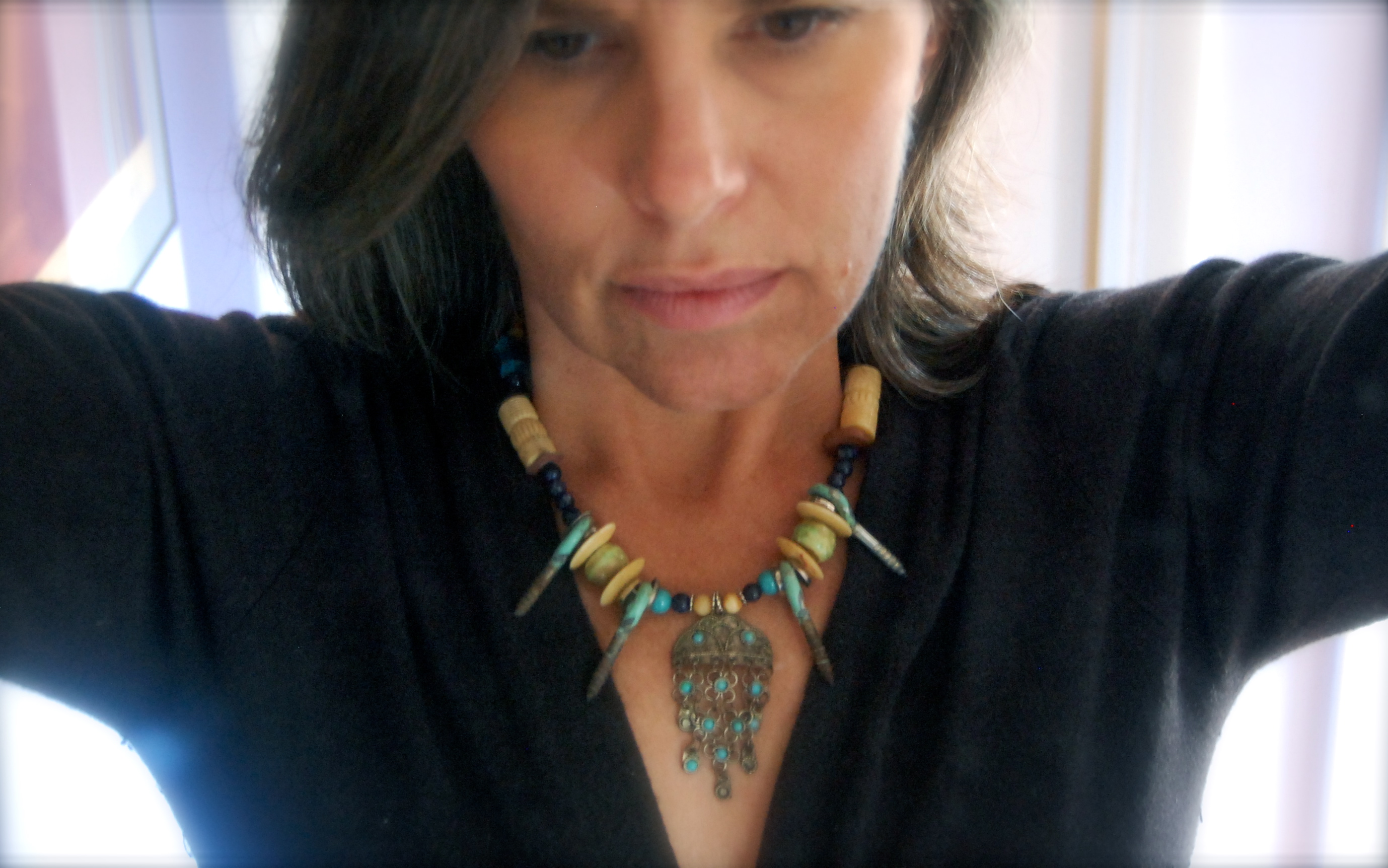
So instead I found my inspiration coming from a show I went to on Friday night at the Gallery at Iona.  Senior artist Joan Shapiro began making necklaces later in life, after a friend who was a jeweler refused a commission, telling her, “Joan.  You are a smart lady.  You can figure this out.”  Which is what she did — magnificently. I’ve never done anything like making jewelry.  I figured out how to string the beads but the first attempt didn’t quite get the sense of domestic bliss that inspired me today.  So I added some things from Tom’s corner workbench.  The coffee cans full of screws and nuts and bolts yielded old, painted and rusted hook eyes and brand spanking new washers that complemented an old earring and various ceramic beads.  A necklace for a domestic goddess, inspired by her domestic god.

Joining two lives together — whether you’ve been together for a while or not long at all — is like stringing the beads.  One at a time.  Balanced. Harmonious.  Beautiful to the ones who choose to wear it.

Congrats to all my friends who have tied the knot lately.