Domestic Gods and Goddesses

Inspiration from an exhibition, a wedding and the great life indoors.

Yesterday a good friend married his long time partner in a sweet and loving ceremony in Georgetown.  As we walked to the reception at the university through the fall leaves and bright sunshine, we were both struck by how different our wedding was from theirs. This couple has been together for quite some time as domestic partners.  Their lives are already completely wound up in and around their wonderful families.  I loved it when the groom’s sister-in-law said in her toast, “I’d say welcome to the family, but you are already a big part of our family.”

Tom and I had only known each other for a short time when we decided to get married almost 25 years ago, and we really had never shared a domestic life before our wedding day.  Our first child was born ten months after our wedding, four months after we bought our first house.  After our first chaotic year together, we found a good way to bring some control into our lives:  We became domestic god and domestic goddess.  Even though we have always been 50/50 partners and we have both worked full-time, Tom had his realm and I had mine.  He does the lawn and the dishes and the laundry.  I cook and am in charge of the inside of the house and was the parent in charge during illness, upset and homework assignments.

The domestic arts have been a good place to be creative.  I have painted the dining room almost as many colors as Benjamin Moore makes.  I have planned kids birthdays and band bashes.  I have decorated each room with care, tried new recipes, taken the Christmas card photos, and served as the organizer of the PTA International Night Talent Show at the middle school, an event that was fraught with terrible diplomatic peril.  As the children grew and I had more time to my own devices, I’ve found other places for that creative energy — in my art making and in my yoga practice.

So when the weather turned chilly today, it was nice to plan a day together to putz around the house.  Tom turned to the yard, and after making a few dinners for the rest of the week, I turned to my little corner studio.  At first, I thought I might paint something from our own wedding, but it was really hard to get inspired to paint on the theme of love when I kept heaving in laughter at the photos in our wedding album. (Tom was so mad at having to take photos while everyone was inside celebrating, that his eyes get more and more intense as you flip pages in the album.  It is really almost like a pop up book when you look at his head.  I on the other hand, look as though I could take flight.  My mother had a 24 inch waist and we had to have her wedding gown altered for me with a ginormous bow on my back. )

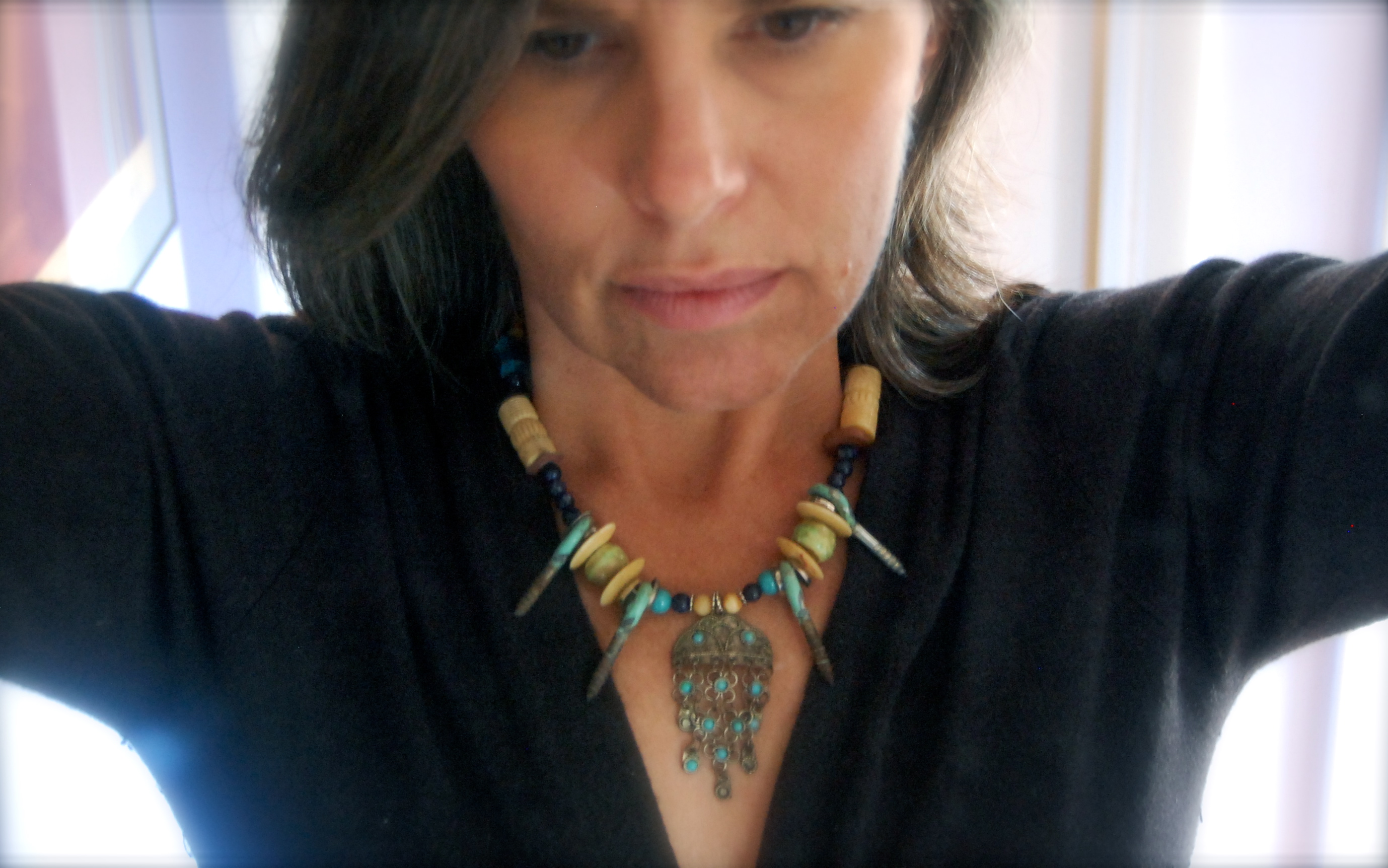
So instead I found my inspiration coming from a show I went to on Friday night at the Gallery at Iona.  Senior artist Joan Shapiro began making necklaces later in life, after a friend who was a jeweler refused a commission, telling her, “Joan.  You are a smart lady.  You can figure this out.”  Which is what she did — magnificently. I’ve never done anything like making jewelry.  I figured out how to string the beads but the first attempt didn’t quite get the sense of domestic bliss that inspired me today.  So I added some things from Tom’s corner workbench.  The coffee cans full of screws and nuts and bolts yielded old, painted and rusted hook eyes and brand spanking new washers that complemented an old earring and various ceramic beads.  A necklace for a domestic goddess, inspired by her domestic god.

Joining two lives together — whether you’ve been together for a while or not long at all — is like stringing the beads.  One at a time.  Balanced. Harmonious.  Beautiful to the ones who choose to wear it.

Congrats to all my friends who have tied the knot lately.
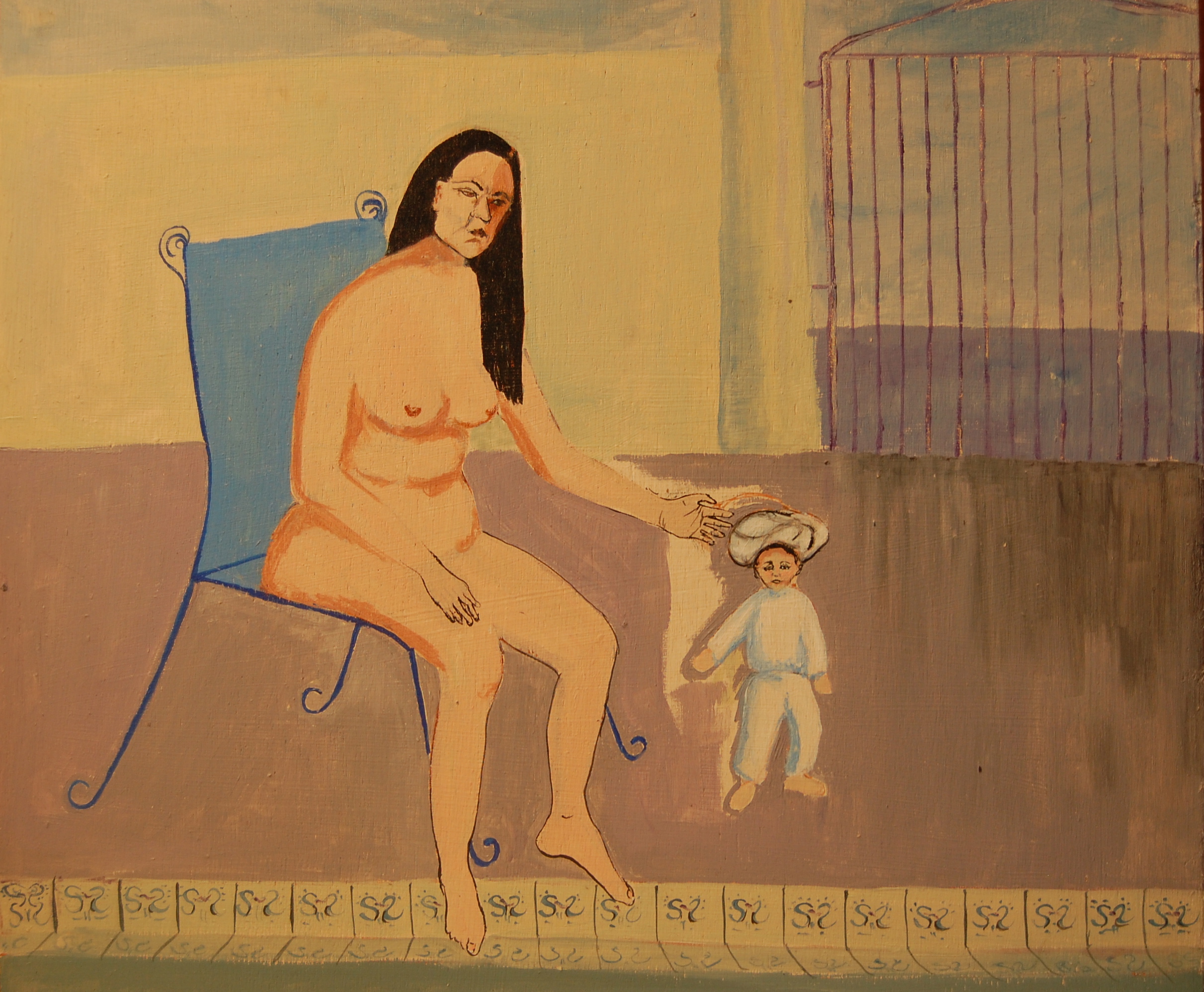
Looking back, fully free

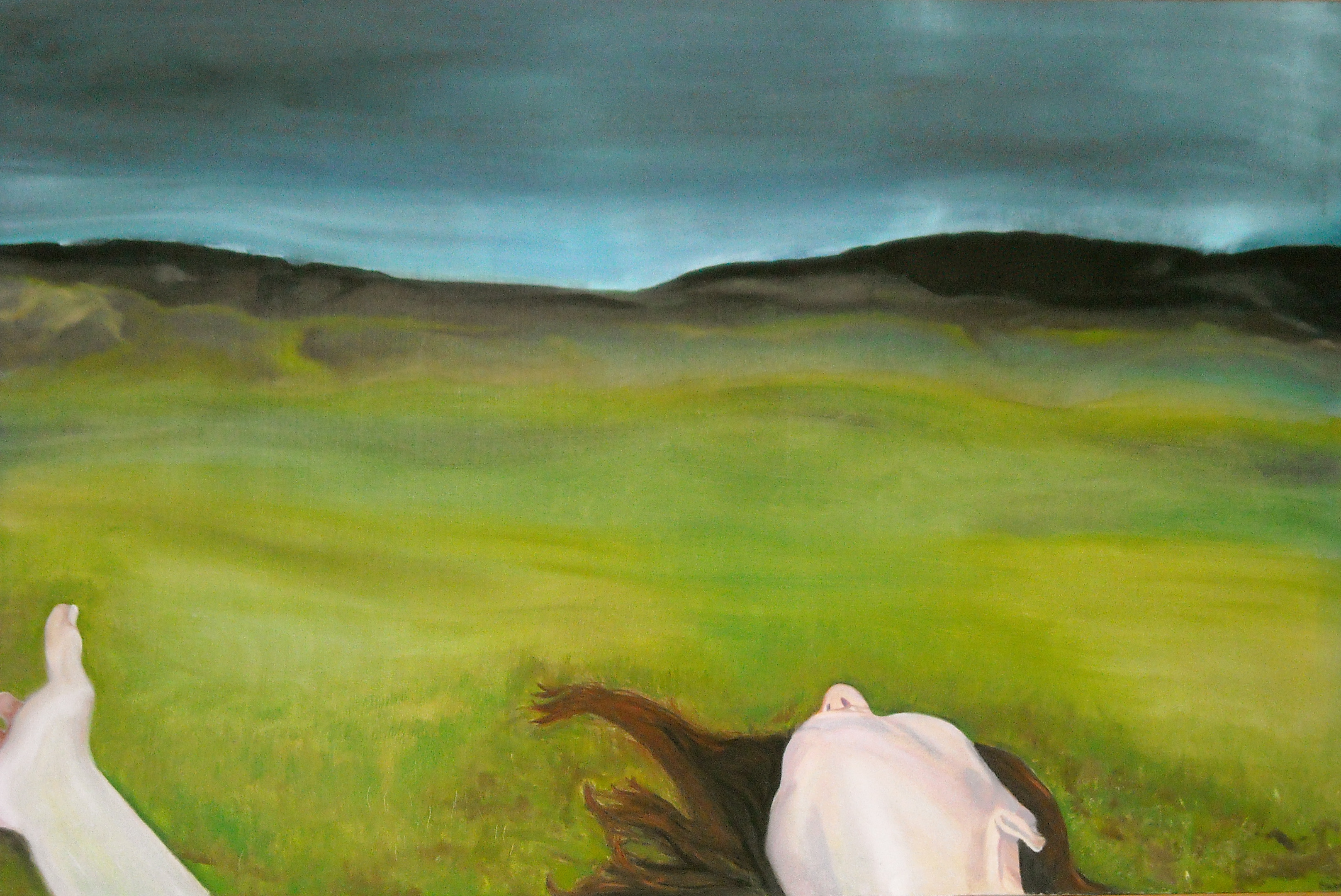
Painted when I was lost and then found, seven years ago.

Most of my psychic energy in the past two weeks has been spent on new and sub classes and leaving my class at Pengu Studio.  On October 1 I started teaching the 7 am class at Tranquil Space Dupont and will begin the 6:45 am class at the Arlington studio on October 16.  On weekends I try out sequences, trying to get the flow right. I worry incessantly, and occasionally in the past week, I’ve been right to worry!  For all my big talk about embracing beginner’s mind, I’m terrible at it. As my beautiful and wise daughter reminded me, everyone is perfectly imperfect. Get over it.

But I don’t want to turn away from the worry, because it has been a dense, rich soil for my creativity.  For example, this month’s asana Bharadvajasana has been an inspiration for me on so many levels.  The pose has so much going on it — part hero, part lotus, deep twist, bind.  As I try it out in my body, I think of Andrew Wyeth’s painting, Christina’s World.  The autumnal colors and the fact that Christina turns away from the viewer gives the painting such a beautiful nostalgia.  But this feeling is balanced by the horizon — there is hopefulness of creation and the freedom of spaciousness.   This is exactly what Wyeth wanted us to take away.  Christina was a neighbor of Wyeth’s who was afflicted by polio, who “was limited physically but by no means spiritually.” Wyeth explained, “The challenge to me was to do justice to her extraordinary conquest of a life which most people would consider hopeless.”  (From the MOMA website. It is part of the permanent collection.)

The pose also brings to mind the Zen teaching:  “The past is already past.  Don’t try to regain it.  The present does not stay.  Don’t try to touch it.  From moment to moment the future will not come.”

Our nature is to turn back, to look for meaning, to right things that went wrong, to revel in the good feelings or wallow in the bad.  And even when we aren’t looking back, the past comes looking for us.

Two Mondays ago was the seventh anniversary of my Mom’s passing.  I hate to admit that this was the first year that I didn’t feel the loss in the marrow of my bones as the day approached.  That evening I ran into one of Mom’s dearest friends at a work reception.  It was a coincidence that was a gift .  It reminded me about what is truly important about my past.  We chatted until way too late about Mom, and I drove home feeling enlivened by the old stories, even the hardest one to relive, that of her last few months.

The next day, I went looking through the past for more of that warm embrace from the past.  I flipped through her correspondence from Bangladesh in the 70s — hoping that there was a message.  Anything for me here?  Lots of talk about Dad’s job, my first Brownie uniform, how much weight my little brother had gained, the incessant monsoon rains, the fabric she used for upholstery on the drab government issued chairs.  Nothing.  Just the past.

Bharadvajasana is fully ground in the present.  The sit bones are ground into the earth, the deep twist coming from the ribcage.  Even though the heart pulls us into the past, our root is in the present.

This poem by Linji has helped me get to this sense of freedom from, in spite of, because of the past:

If you want to be free,

Get to know your real self

It has no form, no appearance

no root, no basis, no abode.

But is lively and buoyant

It responds with versatile facility

But its function cannot be located

Therefore, when you look for it,

You become further from it.

When you seek it, you turn away from it all the more.

Moments of incompetence

Dr. Lovett Weems told this story in his lazy Mississippi drawl:

A preaching professor at a seminary answered the phone late one night to hear one of his recent graduates in what could only be described as a panic.  The graduate explained that he had to prepare for a funeral the next day and needed help.  “I’m happy to help,” the professor explained, “but you learned this just last month.”  Instead of launching into the how-tos, the professor referred his student to the syllabus and to the scripture that might be helpful, hoping to encourage his student.  After he spoke, there was silence.  And then a wail at the end of the other line:  ” But you don’t understand!  This guy’s really dead!”

Dr. Weems explained that real learning happened in these moments of sheer incompetence. I guess I should be thankful that I keep finding myself in these moments, but right now it would be really nice to feel competent.

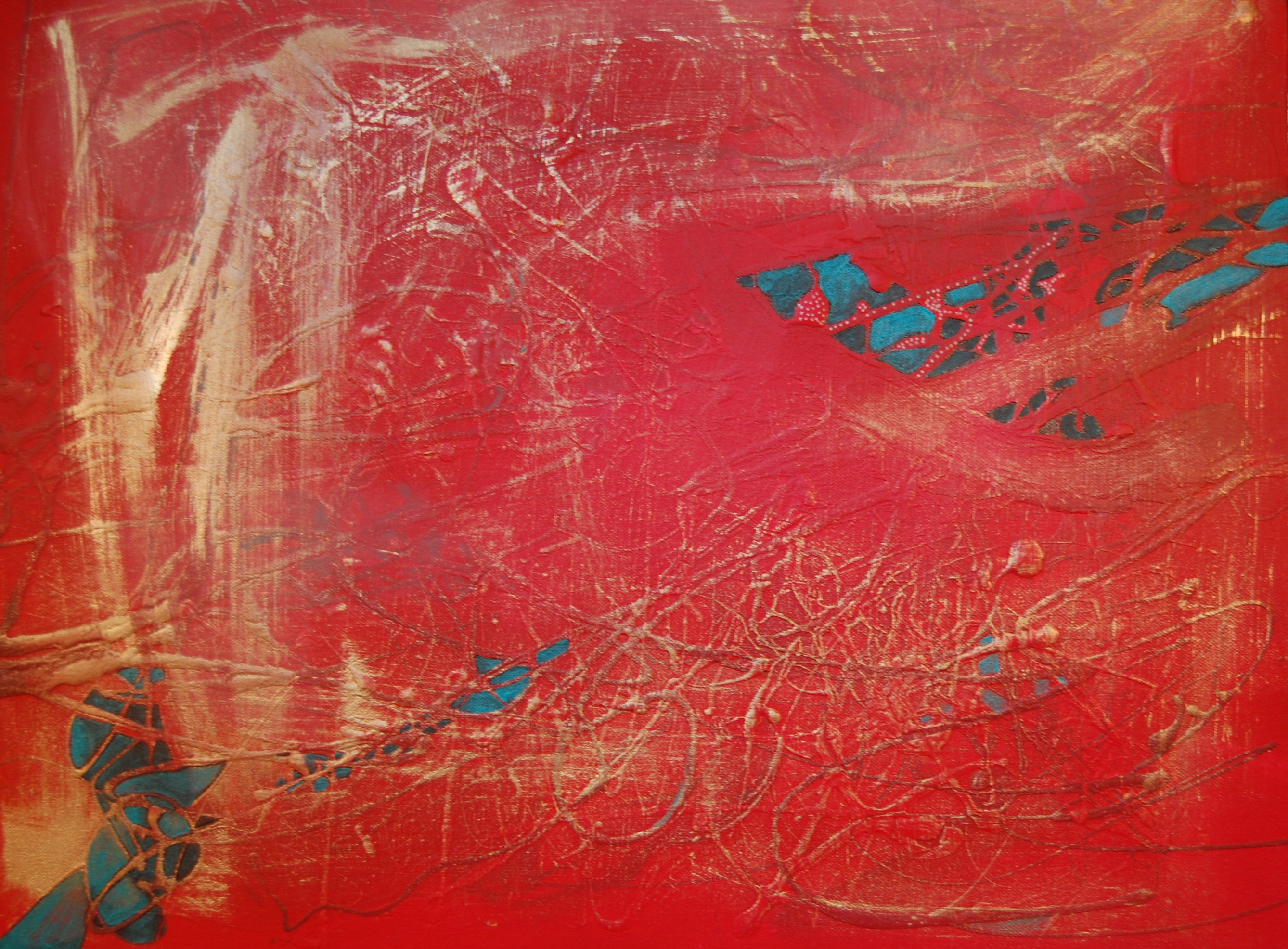
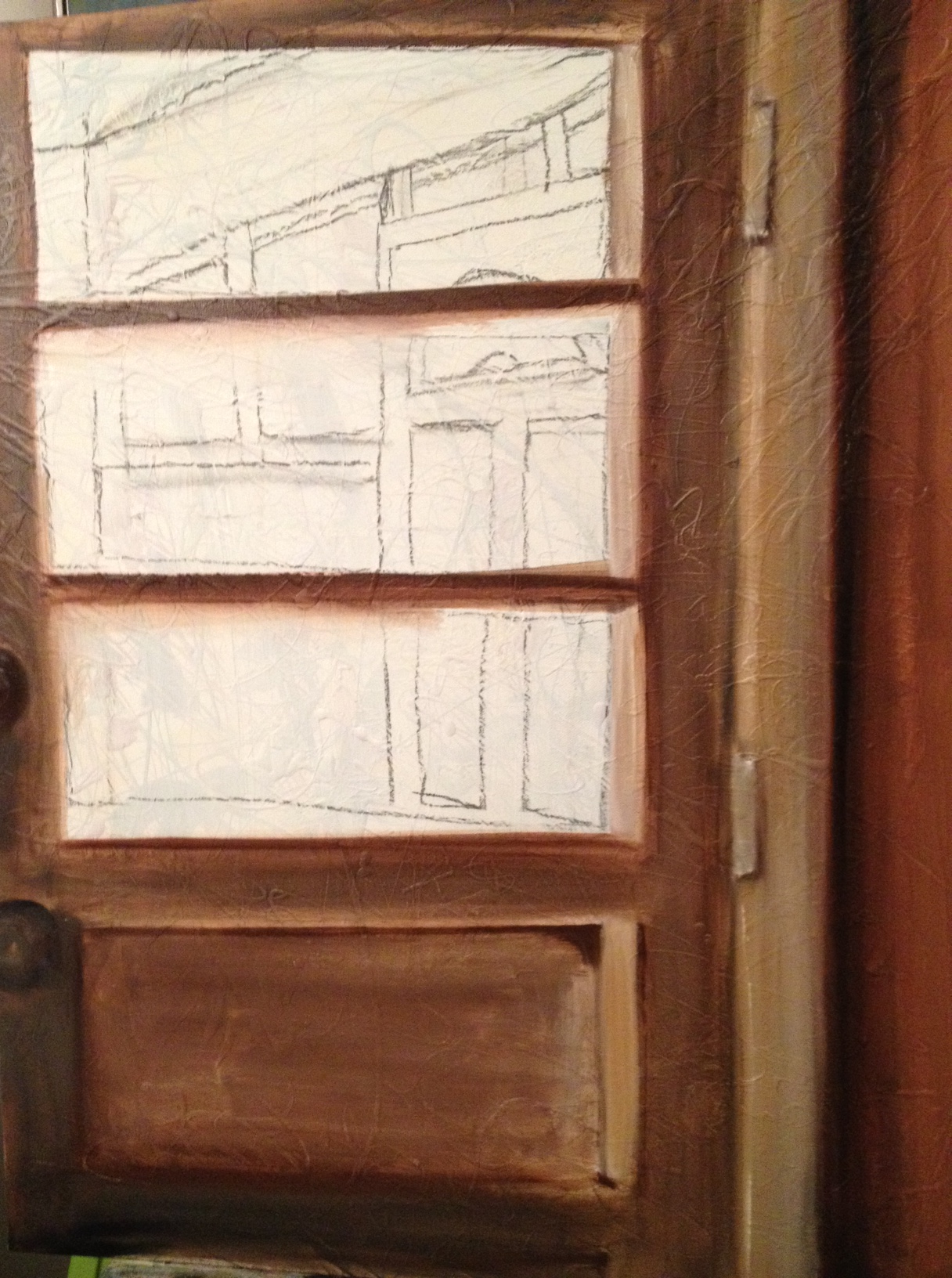
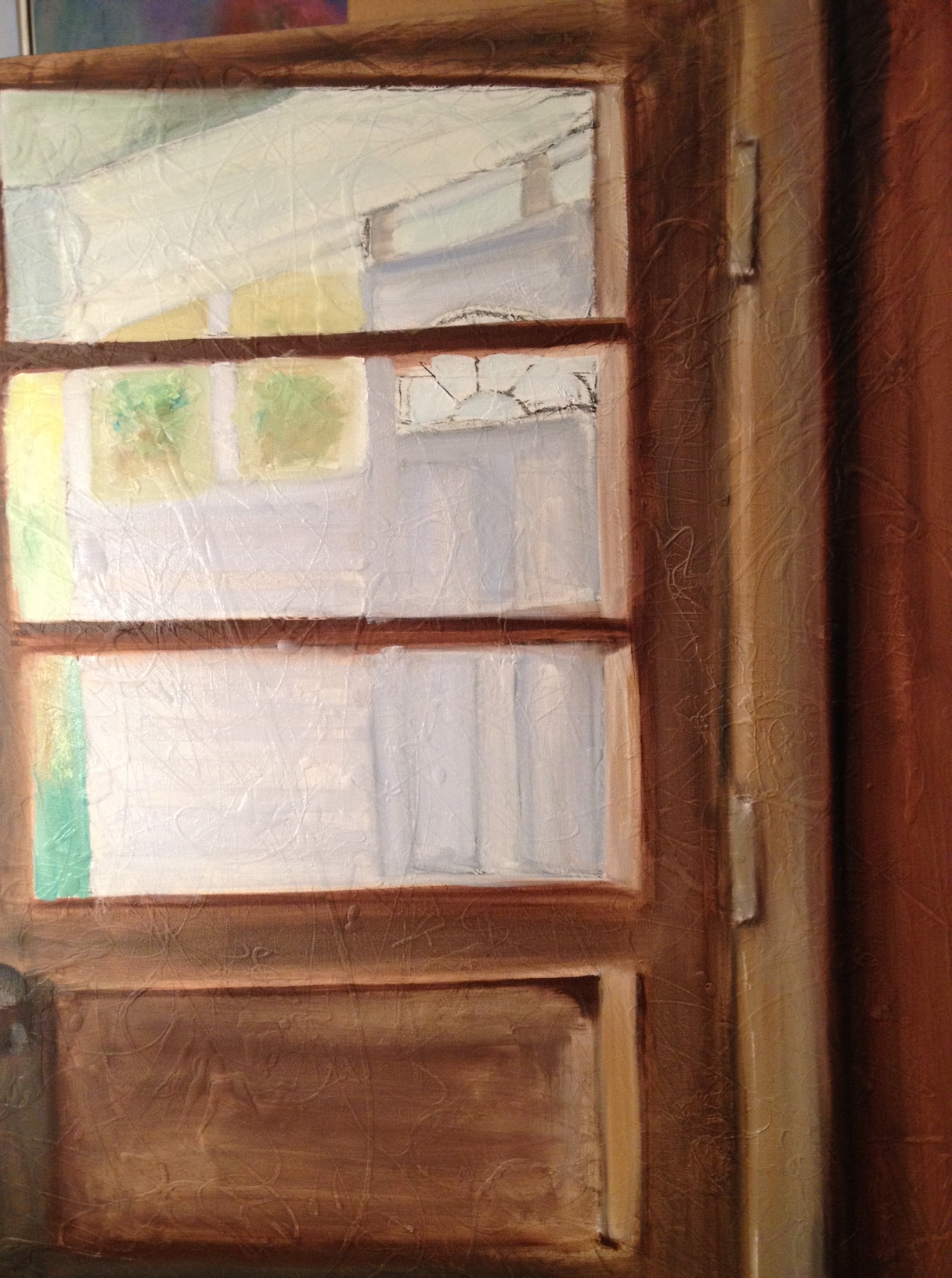
One way I’m feeling incompetent today is that I made the decision to reuse canvases that the art therapist at Iona was throwing away because they had huge acrylic splotches all over them.  I decided these would be just the thing to help me get over the blank canvas issues I was having at the time. The last two posts contain examples of the sense of freedom I felt at one time, splotches and all.  But the acrylic is beginning to be really annoying.  It is hard to draw a straight line.  The perspective in the Joy in Labor post was…labored.  Today, as I faced yet another one of these bumpy painting days, I decided that I couldn’t paint the way I usually do.  I would have to let the bumps have their way.

Playing with form and color

I’ve never felt competent with abstraction, but today the negative space beckoned.  I grabbed a sharpie and started.  An hour later, this is where I am.  Stepping back from the canvas, I was reminded of another painting I did a long time ago.

The very first painting I did was on a piece of board from the basement with five tubes of acrylic paint and one paint brush.  I really can’t remember what made me want to paint — perhaps it was that the kids were growing up and they didn’t need me so much in the evening.  I remember wanting to get this image out. See the black lines?  The blue?  This must be the way I find my way out of a problem.  Black lines and blue.

…and blue. Always blue.

In the practice of yoga, we are reminded that a beginner’s mind is something to be cultivated and valued.  The beginner’s mind has the wisdom of not knowing.  Nothing to say “you can’t do this,” or “don’t even try.”  A beginner’s mind hasn’t started to puff up about what it can do or do well.  It just is ready for the learning.

My take on these similarities is that the black lines allow my mind to focus — to see the form that is calling to me.  The blue is like the sky — open, vast, infinite.  Not a bad place to start to learn something new.  Finding form and sensing the freedom that wisdom brings.

Here’s the passage that I’m playing with as I get ready for tomorrow’s class:

Prevent trouble before it arises.  Put things in order before they exist.  The giant pine tree grows from a tiny sprout.  The journey of 1,000 miles begins beneath your feet.  Rushing into action, you fail.  Trying to grasp things, you lose them.  Forcing a project to completion, you ruin what was almost ripe.  Therefore, the Master takes action by letting things take their corse.  He remains calm at the end as at the beginning.  He has nothing thus has nothing to lose.  What he desires is non-desire.  What he learns is to unlearn.  He simply reminds people of who they have always been.  He cares about nothing by the Tao.  Thus he can care for all things.  

-Lao Tzu

Joy in Labor

A yoga practice is a way of reframing…

About fifteen years ago when I was just a bit lost, a friend took me to dinner and gave me two out-of-print editions of theologian Paul Tillich’s sermons.  At the time I was considering going to seminary.  The sermon “The Meaning of Joy,” found in The New Being (1955, Scribner) is an essay I’ve returned to time and again.  (Although I was not called to study at the seminary, serendipity led me to work there as their fundraiser for four wonderful years.)

Tillich argues that Christianity has lost its way in understanding and reflecting true joy — and I would argue that many of the world’s religions have done just the same, mostly because our basest instincts want to define joy as merely seeking pleasure or avoiding pain.    Tillich’s discussion of the joy of work is what is interesting to me on this Labor Day, particularly because it reminds us how central work is to true joy:

The joy about our work is spoiled when we perform it not because of what we produce but because of the pleasures it can provide us, or the pain against which it can protect us.  The pleasure about the fact that I am successful spoils the joy about the success itself.  Our joy about knowing truth and experiencing beauty is spoiled if we enjoy not the truth and the beauty but the fact that it is I who enjoys them…To seek pleasure for the sake of pleasure is to avoid reality, the reality of other beings and the reality of ourselves.  But only the fulfillment of what we really are can give us joy.  Joy is nothing else that the awareness of our being fulfilled in our true being, in our personal center.  And this fulfillment is possible only if we unite ourselves with what others really are.  It is reality that gives joy and reality alone. …”Rejoice!” That means:  “Penetrate from what seems to be real to that which is really real.”  Mere pleasure, in yourselves and in all other beings, remains in the realm of illusion about reality.  Joy is born out of union with reality itself. (pp. 145 -147)

Tillich’s essay brings us the same wisdom about joy as does Patajali’s Yoga Sutras.  True joy is discovered in understanding that it is illusion that keeps us separate from each other and from our true selves.  For Patanjali, the eight-fold path is a practice (work) to bring our attention to the fact that we have within us the ability to break through the bonds of ignorance that keep us from enlightenment — pure joy — our true selves.  Patajali says that the veil of illusion makes us “confus[e] the temporary for the eternal, the impure for the pure, misery for happiness, and the false self for the true Self. (Yoga Sutras 2.5).  (See www.swamij.com for more.  Great site shared with Tranquil Space teachers-in-training by Kevin Waldorf-Cruz.)

…and refining our knowledge, getting to what is really real.

I’ve had jobs that have kept me in the comfortable veil of illusion.  My personal “misery for happiness” illusion was thinking that I would get the golden ticket when I was a Mom of a toddler and a second grader, commuting 2 hours a day. When I was laid off from this job, I found a part-time (but really full-time) job helping a church build a mission into a free-standing non-profit organization serving vulnerable children with after school arts programming.  At the time, taking the Project Create job seemed self-indulgent.  Even though I was securing funding, developing the board, writing the 501(c)3 paperwork, hiring artists, keeping track of supply inventory and schlepping children all over town in a church van, I felt that I was hiding from the “real” world, licking my wounds.  But it was this job that was the realest of the real.  It allowed me to serve people who needed help.  It gave me the gift of hard physical labor.  I was able to develop or discover talents that would take to serve others.  Finally, this part-time job gave me time freedom that led to three other part-time jobs — one of which was with the Corcoran College of Art and Design, where I started to study and found more bliss in my own self-expression.

A yoga practice allows us to test, reframe and refine our knowledge each time we step on the mat and then asks that we take wisdom off the mat and into the world. The mat marks the path to our true selves that will not only give us, but also will allow us to reflect joy.

Thank you to all the wonderful friends at Iona Senior Services  as I celebrate five years of service this month.  Love the work — love you all!