art

Woo. Way too much doing.

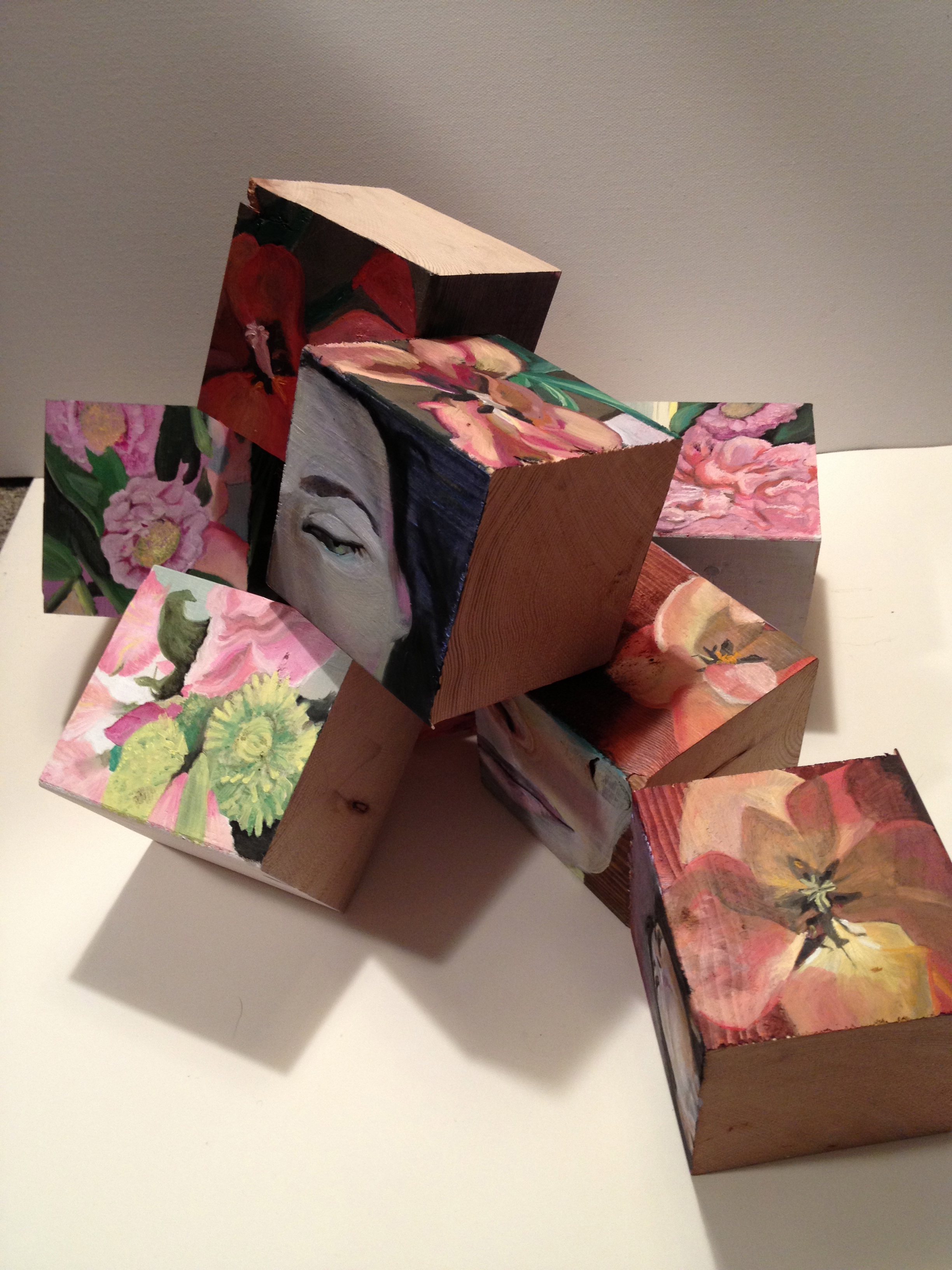
More blocks

More blocks

Mother’s day flew past in a whirlwind of doing. Our major fundraiser at work on May 3 was the most successful yet. It required considering the “what ifs” and “what happens when,” reams of paper with seat assignments, thinking through processes of pledges received and acknowledged, of financial reports to file and contracts to sign. I was drained by the time Tom and I got away to celebrate a strange new mother’s day without our mothers or anyone around to mother. But the doing kept us moving forward — there was packing, driving, friends to see, the beach, the great new restaurant in town…then, back at work to refocus on website redesign which has been left too long, teaching more classes than normal, Emma’s homecoming, a weekend workshop with Tias Little at Sun and Moon Yoga Studio…and today, the inevitable wall. Thud.

My body has told me that I must undo the effects of charging my adrenal gland up to the max. I must un-do and non-do.

So how ironic is it that on my day of non-doing, I am pulled to the studio to the 29 blocks in our laundry basket, awaiting transformation? I painted this facade today, inspired by the poem by Wendy Videlock, written for her mother:

Flowers

They are fleeting.

They are fragile.

They require

little water.

They’ll surprise you.

They’ll remind you

that they aren’t

and they are you.

I’d found the poem about a month ago when the flowers for Dorothy’s funeral were fading and I took pictures to remember them. Today, as I painted this facade, I lost myself in the process of painting — in the color and the line. Even though I was doing, I was undoing — undoing some of the sadness of my mother’s and Dorothy’s passing, of the exhaustion I feel today and other negative emotions that have been stuffed and packed in nooks and crannies of my body, mind and spirit. There is no tomorrow and no yesterday. Just this moment, this brush stroke.

As Tias explains in an article he wrote for the Sun and Moon newsletter, in the Taoist tradition, non-doing is “wu-wei,” a highly esteemed way of living life. His workshop helped us instinctually understand that we are “doer devotees” and that this approach is antithetical to yoga. The first session of his workshop started with sitting in meditation, listening for the deep thunderous silence rumbling. Today, I heard a moment of this silence as I became a flower.
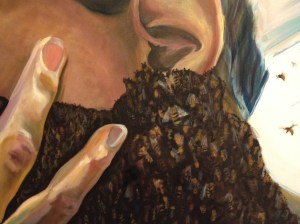
Nothing Says Christmas Like Bees

Image

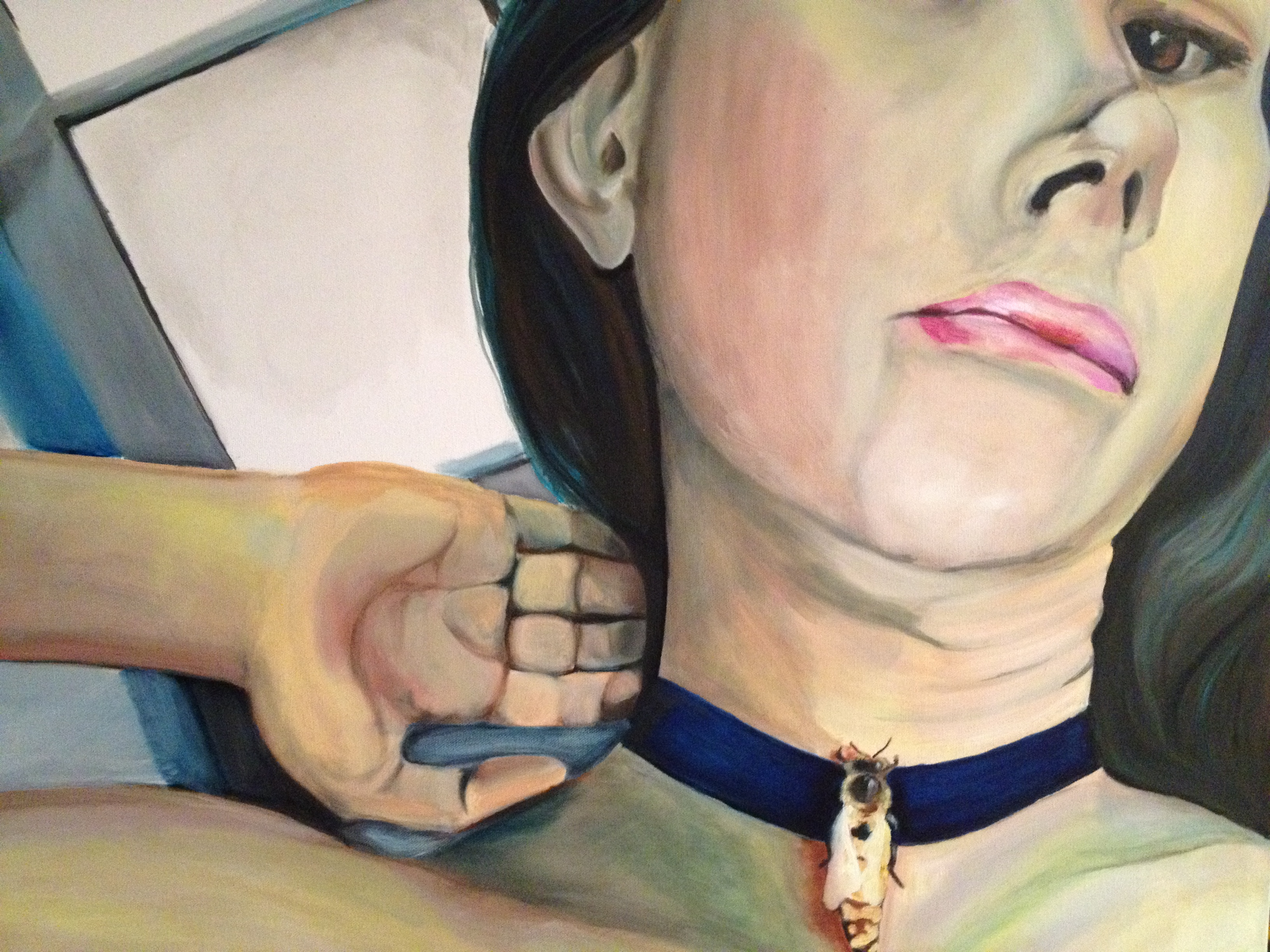
To make a bee beard, one starts with tying the queen to the neck.

For the longest time, I’ve been working on a “prequel” to my painting of a bee beard.  I got serious as my 49th birthday approached.  I found that I was industrious about the task — not getting stuck in old ways of over-thinking the concept, or of perfectionism about the line or form, or becoming bored by the tasks I had laid out for myself day by day.  I just got to work and when I was tired, I laid down the brush.  I was…well, like a bee. The result is here.

When I did let myself ruminate on bees and bee beards, I couldn’t remember why I wanted to paint them at all. I’m sure it originally related to the concept of apples and honey that I had painted as I worked through the Eve and the Garden series so long ago.  Just wanting to keep that alive.  The bee beard painted itself almost,  and remained an oddity — a question mark.  It needed a prequel. Here’s the painting of the bee beard:

bee beard

I looked up the meaning of the symbol of bees in the illustrated encyclopedia of traditional symbols and began to get a murky sign from the universe about why I had chosen the subject, and to my sensibilities they seem holiday oriented. The bee is a sign of immortality, rebirth, industry, order, purity and a soul.  In Christianity, the bee is a symbol Mary, mother of Jesus; in Hinduism, the bee on a lotus is the symbol of Vishnu.

The symbol of the ancient Greek goddess Demeter is the bee.  She is sometimes called the “pure Mother Bee,” and the Greeks worshipped her as the bringer of the harvest.  In ancient times to whisper something to a bee would bring the message to the spirit world.

The way these paintings came to me felt as though they were a whisper to me from a place of collective and universal consciousness.  I found joy in the process of painting them and then in thinking about what I had painted, rather than what I would paint.

Bees, I’m sure, don’t think about the honey either.  Hope I can carry this into the new year.

And now, a beautiful poem about bee beards given to me after she saw the strange bee beard painting by my dear friend and amazing poet and artist Marie Pavlicek-Werhli:

The Girl with Bees in Her Hair

BY ELEANOR WILNER

came in an envelope with no return address;
she was small, wore wrinkled dress of figured
cotton, full from neck to ankles, with a button
of bone at the throat, a collar of torn lace.
She was standing before a monumental house—
on the scale you see in certain English films:
urns, curved drives, stone lions, and an entrance far
too vast for any home. She was not of that place,
for she had a foreign look, and tangled black hair,
and an ikon, heavy and strange, dangling from
an oversize chain around her neck, that looked
as if some tall adult had taken it from his,
and hung it there as a charm to keep her safe
from a world of infinite harm that soon
would take him far from her, and leave her
standing, as she stood now—barefoot, gazing
without expression into distance, away
from the grandeur of that house, its gravel
walks and sculpted gardens. She carried a basket
full of flames, but whether fire or flowers
with crimson petals shading toward a central gold,
was hard to say—though certainly, it burned,
and the light within it had nowhere else
to go, and so fed on itself, intensified its red
and burning glow, the only color in the scene.
The rest was done in grays, light and shadow
as they played along her dress, across her face,
and through her midnight hair, lively with bees.
At first they seemed just errant bits of shade,
until the humming grew too loud to be denied
as the bees flew in and out, as if choreographed
in a country dance between the fields of sun
and the black tangle of her hair.
                                                   Without warning
a window on one of the upper floors flew open—
wind had caught the casement, a silken length
of curtain filled like a billowing sail—the bees
began to stream out from her hair, straight
to the single opening in the high facade. Inside,
a moment later—the sound of screams.
The girl—who had through all of this seemed
unconcerned and blank—all at once looked up.
She shook her head, her mane of hair freed
of its burden of bees, and walked away,
out of the picture frame, far beyond
the confines of the envelope that brought her
image here—here, where the days grow longer
now, the air begins to warm, dread grows to
fear among us, and the bees swarm.

Eleanor Rand Wilner, “The Girl with Bees in Her Hair” from The Girl with Bees in Her Hair. Copyright © 2004 by Eleanor Rand Wilner. Used by permission of Copper Canyon Press, www.coppercanyonpress.org.

Rose Hips and Rosy Hips

I don’t know where I learned that the hips are where we store all of our emotions. I know it to be true though. When I’ve had a deep hip opening practice I feel like a dam has burst, and a few times this has ended in cleansing tears, much to the consternation of my family. Nevertheless, I resist hip openers in my own practice and haven’t found a really good way to work deep hip openers like pigeon pose into the hour-long early morning practice that I teach at Tranquil Space. My friend Alyson reminded me how much people love them, and so today I settled the class into pigeon and found my own heart opening vicariously.

I’d guess that hips have been on my mind for a while now. My own hips and the struggle against spread now that I’m fully planted in my middle-aged years. My daughter’s hips as I’ve watched as they’ve grown from boyish to beautiful in the past five years. My father’s and brother’s hips now that they are successfully replaced with titanium. When I cue asanas in class I feel as though I keep harping on “squaring the hips,” and have to smile to think of my mentor’s comment about “honest hips” in yoga practice.

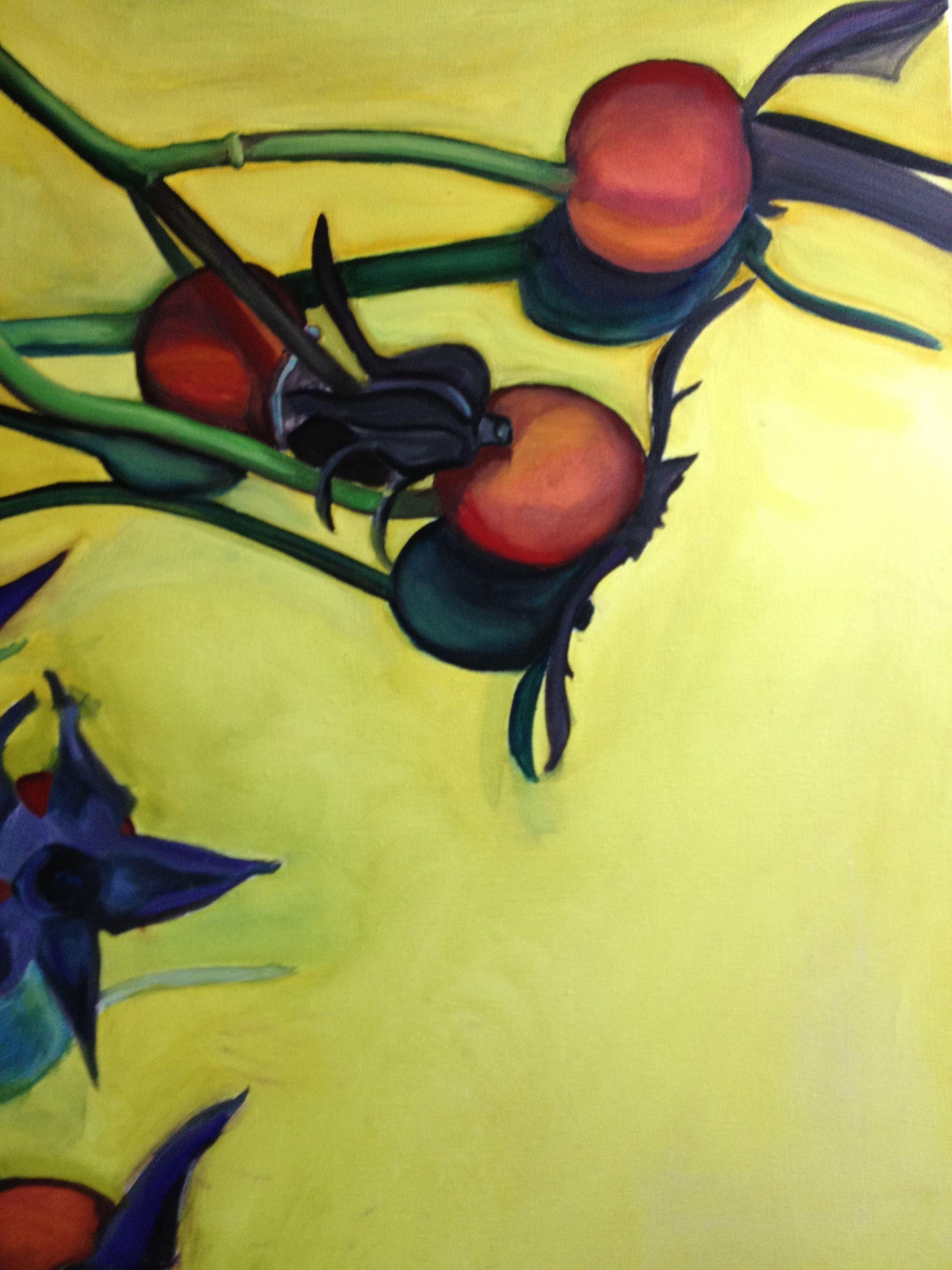
I’ve also been working on this painting of rose hips, which are unusual in our severely landscaped neighborhood. Tom and I are notoriously terrible gardeners — we like to say that we grow children, not plants. A rose bush that I planted in the front yard has grown amok — sometimes falling over, other times hastily nailed up to the house, most of the time annoying Tom as he mows the front yard. We love to see it on that one week of the year when it is gloriously in bloom, then don’t pay it a bit of attention until the next year. It is a canopy to the window well where I keep my easel, and so when a sweet little chipmunk showed up to gnaw on acorns in front of the window as I was waiting for inspiration, I paid attention to him and then to the rose bush, which was covered in rose hips.

Rose bushes that aren’t well groomed grow rose hips — a fruit which holds rose seeds. And like all things in nature that are left to a little chaos, the lack of control can lead to wonderful sustenance. You can clip rose hips and make tea with a few of them, and jam if you have buckets of them. They have huge amounts of vitamin C and anti-oxidants. Thinking of eating this fruit reminds me of childhood. I can remember as a child having rose water liberally sprinkled on food. Or the Chartreuse green of Rose’s Lime Juice in a glass of soda and raw sugar. (Perhaps this is where the green-yellow comes from in the background of this painting.)

The pose of the month at the studio is bakasana, crow pose. This powerful pose requires open hips and a fearless heart as you hoist yourself up on the upper arms, balancing on hands, almost kissing the ground. The fruit of this pose is an open heart — tapping into emotions buried deep in the hip. As Alanna Kaivalya explains in Myths of the Asanas:

There’s a striking contrast between the way humans hold on to fear and the way animals freely let go of it…Asanas give us the opportunity to do just the same. We get the chance to move our life experience through our bodies by taking the shapes of the various forms in nature. We stretch and create space in our joints and muscles and do our best to embody the essence of each posture, learning its inherent lessons and experiencing freedom in that form. When this process takes hold and begins to release the fear from our body and our heart, we are able to live our lives joyfully, moment to moment. Fear lives in us as tension, and asana postures are designed to release tension from our bodies. The absence of tension is the absence of fear. And the absence of fear signifies the presence of joy, love and open-heartedness. As we embody these shapes in nature, we learn to fall in love with the world around us.

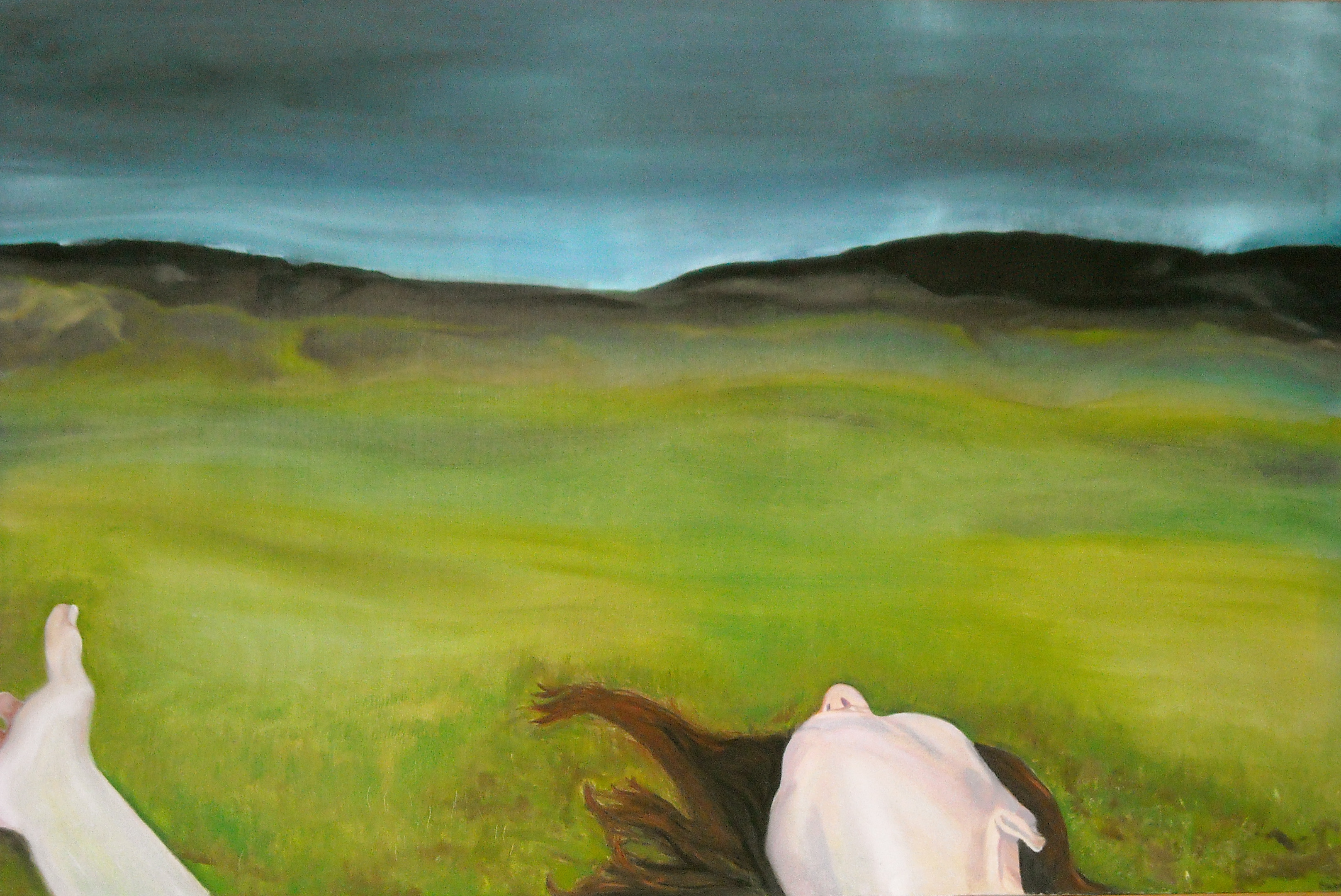
Looking back, fully free

Painted when I was lost and then found, seven years ago.

Most of my psychic energy in the past two weeks has been spent on new and sub classes and leaving my class at Pengu Studio.  On October 1 I started teaching the 7 am class at Tranquil Space Dupont and will begin the 6:45 am class at the Arlington studio on October 16.  On weekends I try out sequences, trying to get the flow right. I worry incessantly, and occasionally in the past week, I’ve been right to worry!  For all my big talk about embracing beginner’s mind, I’m terrible at it. As my beautiful and wise daughter reminded me, everyone is perfectly imperfect. Get over it.

But I don’t want to turn away from the worry, because it has been a dense, rich soil for my creativity.  For example, this month’s asana Bharadvajasana has been an inspiration for me on so many levels.  The pose has so much going on it — part hero, part lotus, deep twist, bind.  As I try it out in my body, I think of Andrew Wyeth’s painting, Christina’s World.  The autumnal colors and the fact that Christina turns away from the viewer gives the painting such a beautiful nostalgia.  But this feeling is balanced by the horizon — there is hopefulness of creation and the freedom of spaciousness.   This is exactly what Wyeth wanted us to take away.  Christina was a neighbor of Wyeth’s who was afflicted by polio, who “was limited physically but by no means spiritually.” Wyeth explained, “The challenge to me was to do justice to her extraordinary conquest of a life which most people would consider hopeless.”  (From the MOMA website. It is part of the permanent collection.)

The pose also brings to mind the Zen teaching:  “The past is already past.  Don’t try to regain it.  The present does not stay.  Don’t try to touch it.  From moment to moment the future will not come.”

Our nature is to turn back, to look for meaning, to right things that went wrong, to revel in the good feelings or wallow in the bad.  And even when we aren’t looking back, the past comes looking for us.

Two Mondays ago was the seventh anniversary of my Mom’s passing.  I hate to admit that this was the first year that I didn’t feel the loss in the marrow of my bones as the day approached.  That evening I ran into one of Mom’s dearest friends at a work reception.  It was a coincidence that was a gift .  It reminded me about what is truly important about my past.  We chatted until way too late about Mom, and I drove home feeling enlivened by the old stories, even the hardest one to relive, that of her last few months.

The next day, I went looking through the past for more of that warm embrace from the past.  I flipped through her correspondence from Bangladesh in the 70s — hoping that there was a message.  Anything for me here?  Lots of talk about Dad’s job, my first Brownie uniform, how much weight my little brother had gained, the incessant monsoon rains, the fabric she used for upholstery on the drab government issued chairs.  Nothing.  Just the past.

Bharadvajasana is fully ground in the present.  The sit bones are ground into the earth, the deep twist coming from the ribcage.  Even though the heart pulls us into the past, our root is in the present.

This poem by Linji has helped me get to this sense of freedom from, in spite of, because of the past:

If you want to be free,

Get to know your real self

It has no form, no appearance

no root, no basis, no abode.

But is lively and buoyant

It responds with versatile facility

But its function cannot be located

Therefore, when you look for it,

You become further from it.

When you seek it, you turn away from it all the more.