art

Moments of incompetence

Dr. Lovett Weems told this story in his lazy Mississippi drawl:

A preaching professor at a seminary answered the phone late one night to hear one of his recent graduates in what could only be described as a panic.  The graduate explained that he had to prepare for a funeral the next day and needed help.  “I’m happy to help,” the professor explained, “but you learned this just last month.”  Instead of launching into the how-tos, the professor referred his student to the syllabus and to the scripture that might be helpful, hoping to encourage his student.  After he spoke, there was silence.  And then a wail at the end of the other line:  ” But you don’t understand!  This guy’s really dead!”

Dr. Weems explained that real learning happened in these moments of sheer incompetence. I guess I should be thankful that I keep finding myself in these moments, but right now it would be really nice to feel competent.

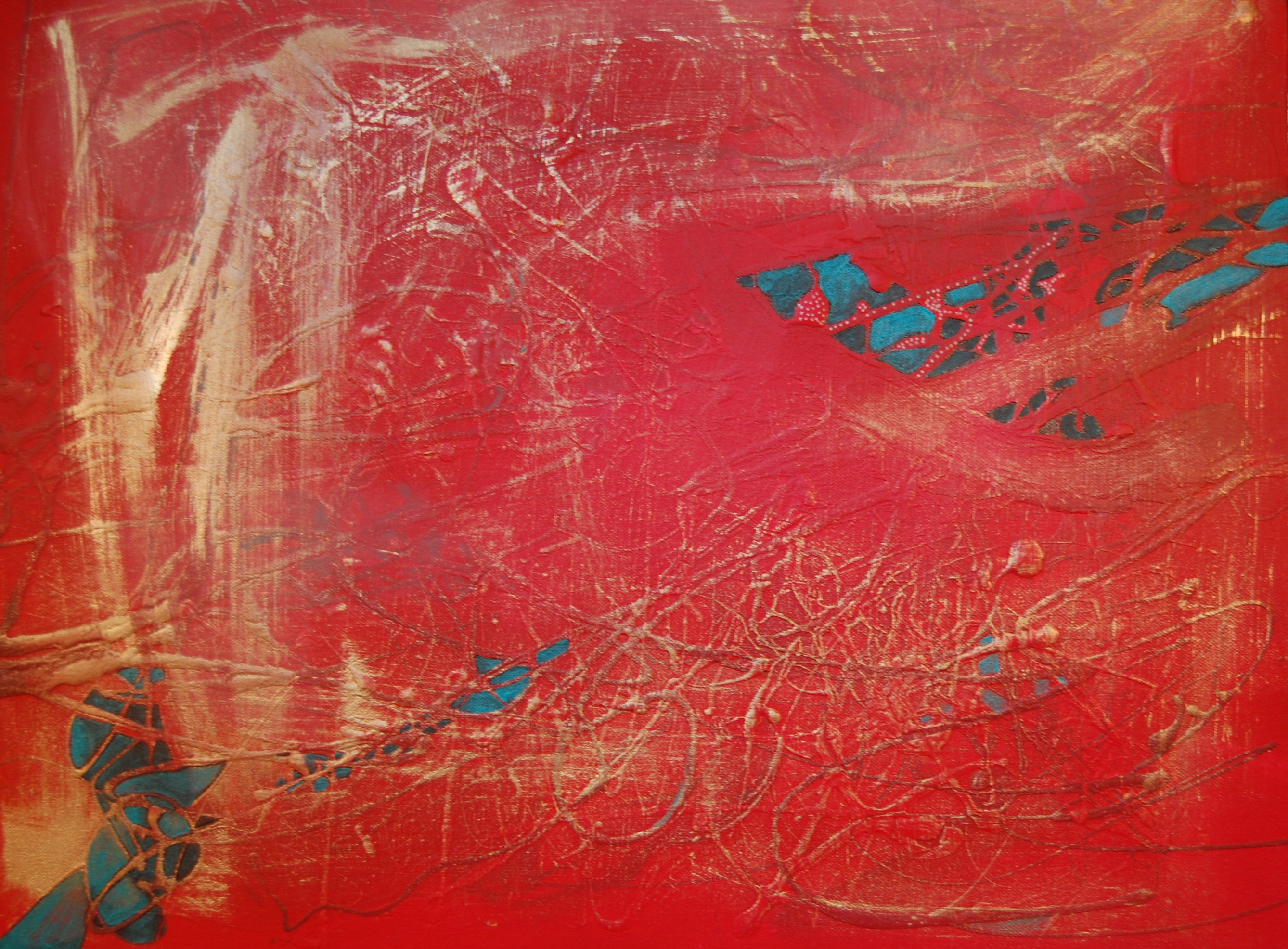
One way I’m feeling incompetent today is that I made the decision to reuse canvases that the art therapist at Iona was throwing away because they had huge acrylic splotches all over them.  I decided these would be just the thing to help me get over the blank canvas issues I was having at the time. The last two posts contain examples of the sense of freedom I felt at one time, splotches and all.  But the acrylic is beginning to be really annoying.  It is hard to draw a straight line.  The perspective in the Joy in Labor post was…labored.  Today, as I faced yet another one of these bumpy painting days, I decided that I couldn’t paint the way I usually do.  I would have to let the bumps have their way.
Playing with form and color

I’ve never felt competent with abstraction, but today the negative space beckoned.  I grabbed a sharpie and started.  An hour later, this is where I am.  Stepping back from the canvas, I was reminded of another painting I did a long time ago.

The very first painting I did was on a piece of board from the basement with five tubes of acrylic paint and one paint brush.  I really can’t remember what made me want to paint — perhaps it was that the kids were growing up and they didn’t need me so much in the evening.  I remember wanting to get this image out. See the black lines?  The blue?  This must be the way I find my way out of a problem.  Black lines and blue.
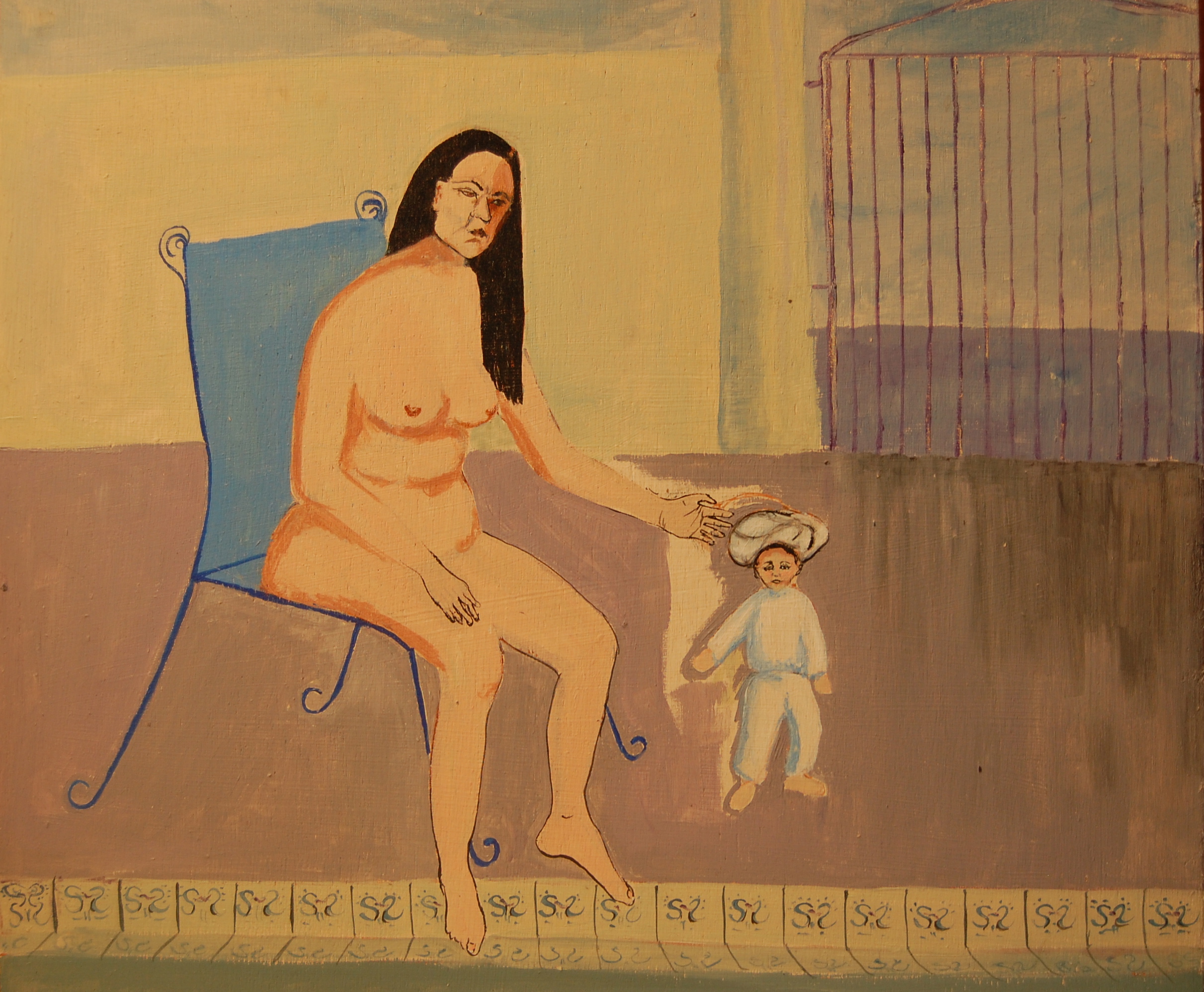
…and blue. Always blue.

In the practice of yoga, we are reminded that a beginner’s mind is something to be cultivated and valued.  The beginner’s mind has the wisdom of not knowing.  Nothing to say “you can’t do this,” or “don’t even try.”  A beginner’s mind hasn’t started to puff up about what it can do or do well.  It just is ready for the learning.

My take on these similarities is that the black lines allow my mind to focus — to see the form that is calling to me.  The blue is like the sky — open, vast, infinite.  Not a bad place to start to learn something new.  Finding form and sensing the freedom that wisdom brings.

Here’s the passage that I’m playing with as I get ready for tomorrow’s class:

Prevent trouble before it arises.  Put things in order before they exist.  The giant pine tree grows from a tiny sprout.  The journey of 1,000 miles begins beneath your feet.  Rushing into action, you fail.  Trying to grasp things, you lose them.  Forcing a project to completion, you ruin what was almost ripe.  Therefore, the Master takes action by letting things take their corse.  He remains calm at the end as at the beginning.  He has nothing thus has nothing to lose.  What he desires is non-desire.  What he learns is to unlearn.  He simply reminds people of who they have always been.  He cares about nothing by the Tao.  Thus he can care for all things.  

-Lao Tzu
Parental Creativity


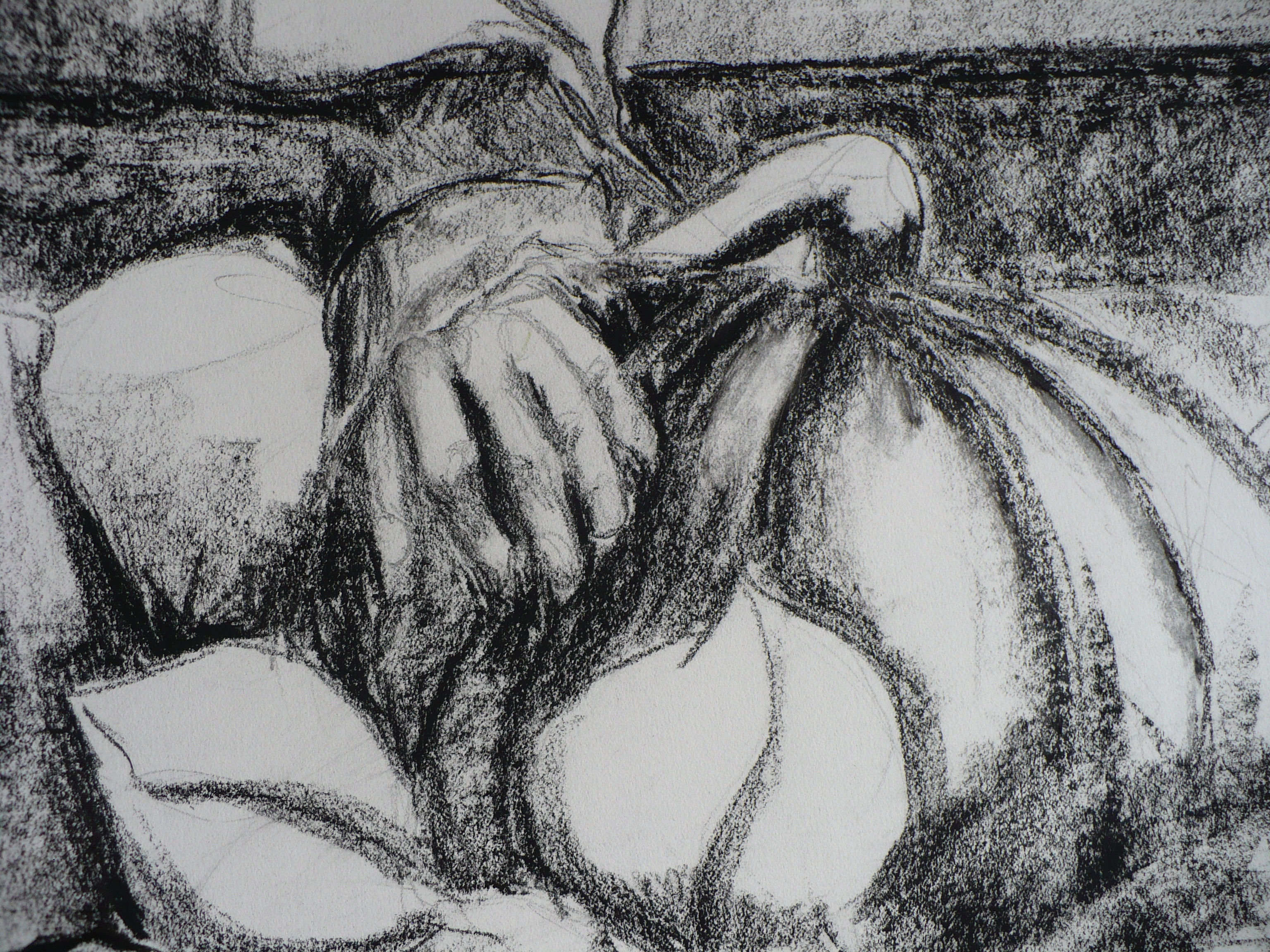
…and protected them when the world outside was cold…

My youngest will leave for college in a month and a half.  Part of why I’ve taken up an intentional and active practice in creating art and teaching yoga is because I’m about to release one of our last human creations out into the world.  My “parenting” (how I really hate that word — but nothing seems to work as well in this context) will now happen on text and in email and during holding-back-tears conversations on the phone on Sunday nights.

This might be why in a moment of peaceful clarity I had an idea about writing a children’s book about a couple who raise pumpkins and raise children.  Where the text flowed out into my sketchbook in an evening, I’m now taking my time with the drawings, which I then plan to take my time translating into colorful oil paintings.  I want this creative process to be like raising my children.  Like raising children (or raising pumpkins) good things come to those who take the time, who are truly present, and who let love and positive energy flow through them to help growth. Because what is the goal of being a parent but the process of learning to love profoundly and deeply?  What is the goal of being an artist?  A yogi? Through parenting, creating art, practicing asana we learn that even when things do go awry and they will, they will…  we can always return to the grace of the practice of time, presence, love and positive energy.

Similarly, teaching yoga takes time too.  I’ve just signed on to teach Tuesdays and Thursdays at 6:15 am at a studio near my home.  (See the Classes page for the exact details.) I’ve only been there two weeks, but already I find myself blessed with the seed of love taking hold of me — thinking about how this asana might be interesting for one or fun for another or good for them all. We don’t get to choose our parents or our children, and in many ways our yoga teachers are luck of the draw too.  I pray I can continue to take the time I need to be truly present to the students who are that dedicated to their practice to show up early in the morning, and to let the love and positive energy flow through me to them.  Especially in the winter, when rising at 5 am will be a bit more difficult!

From Judith Lasater’s Living Your Yoga: Finding the Spiritual in Everyday Life

Sometimes I notice my yoga students practicing their less than favorite poses with a ho-hum attitude.  At these moments, I remind them that although yoga is powerful, it cannot transform us unless we love it.  When we love, we are receptive to the “other.”  When we love, we are vulnerable.  Although being vulnerable can be frightening, it is also the doorway to the ultimate freedom written about in book four, verse twenty-two of the Bhagavad Gita…   ‘Content with what is chance-obtained, transcending the opposites, without envy, the same in success and failure, though performing actions — he is not bound.’ 

Here, Krishna explains what life is like when you are not bound by the attraction of opposites, and that when this state is experiences, there is no reaction to the vicissitudes of life.  When you react, you are not in a state of love.  When you can love without expectation, you are in a state of pure love.  Mostly what is declared to be love is not.  Rather, it is need, or fear, or the desire for power over another person.  Love in its purest sense is not based upon what you get from the relationship, but on what the relationship allows you to give.  The depth of your love is not reflected in what the other makes you feel, but in your willingness to give of yourself.  Love’s job is to lead you to intimacy with what is enduring in yourself and in others. Whether this connection lasts for seconds or decades, love is not wasted.  Through it, you have been transformed.

On being a recovering creative

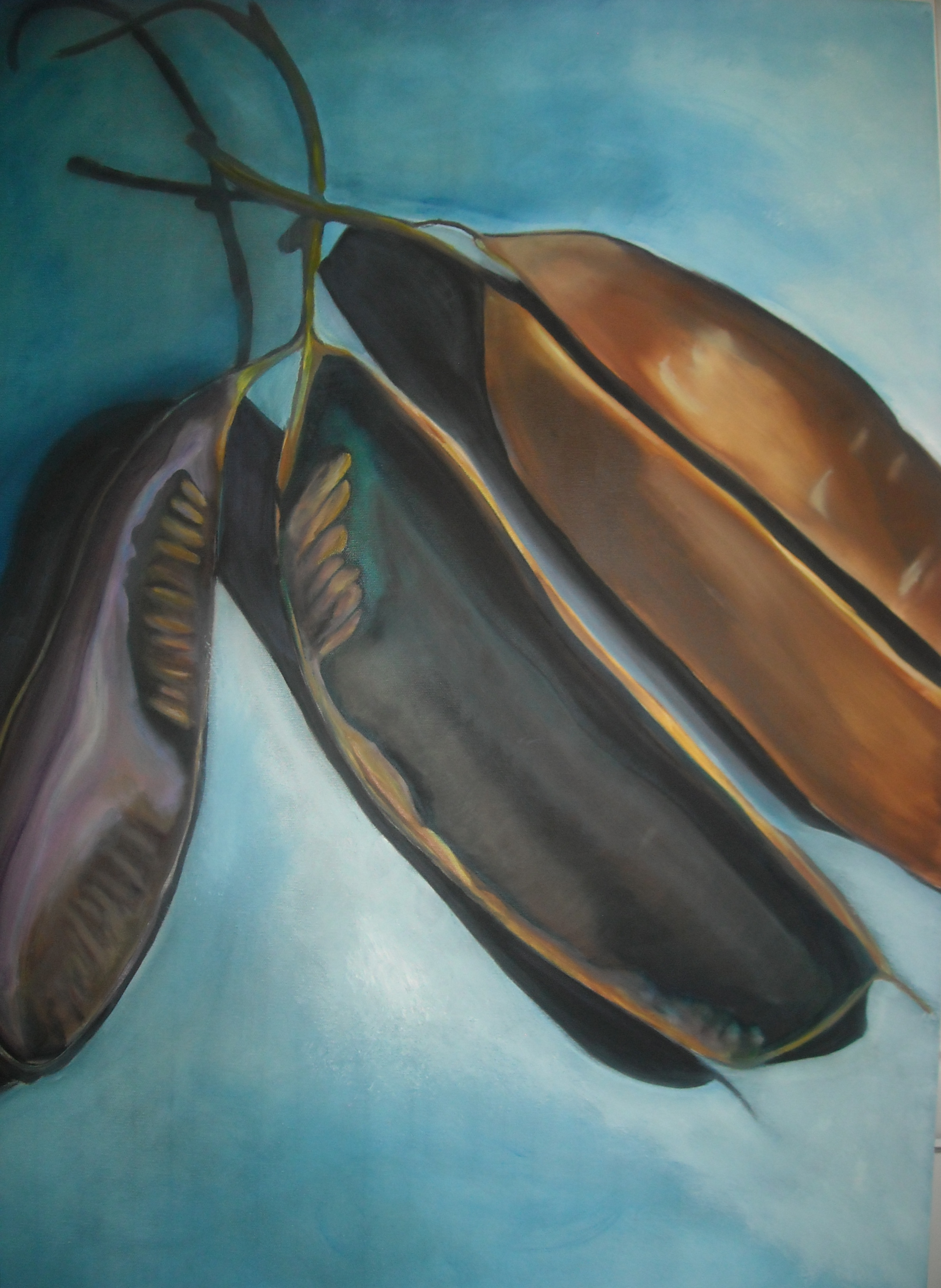
ImageI had lost my artistic mojo.  After a burst of creativity, sitting down to paint had been almost painful.  Nothing flowed.  I was just grasping for ideas that would fade before the paint reached the canvas.  Occasionally I made myself complete a painting but eventually I didn’t even bother squeezing the paint on the palette, since I would lose interest and waste the paint.  But I had my yoga, my family life, things to do.  I was as empty as these dried seed pods.  (I completed this painting during this time — it took me, no kidding, a YEAR.  Every time I look at this painting, I’m amazed at how tortured it was for me.)

On the advice of some very wise people at Tranquil Space, I picked up Julia Cameron’s book The Artist’s Way:  A Spiritual Path to Higher Creativity, (Penguin/Putnam, 1992) and I am now recovering the joy and spontaneity that my creative life had been until I got in the way of myself.

Practicing art and practicing yoga demand that you turn yourself off — get yourself out of your own way.  My art had become all about ME.  What did I think?  What did I want to say in this painting?  What did I think was interesting?  It’s just like how a pose becomes all the more difficult when I find myself thinking about what I look like or how much better I am at this pose now than I was in the past. The lesson is just to do art, not think art.  Just practice.  Be like a transistor radio.

So I get up and do art.  I let the ideas flow from somewhere else.  I just transcribe them. Thanks to friends at the studio and Julia Cameron, I am a recovering creative.