yoga

Joy in Labor

A yoga practice is a way of reframing…

About fifteen years ago when I was just a bit lost, a friend took me to dinner and gave me two out-of-print editions of theologian Paul Tillich’s sermons.  At the time I was considering going to seminary.  The sermon “The Meaning of Joy,” found in The New Being (1955, Scribner) is an essay I’ve returned to time and again.  (Although I was not called to study at the seminary, serendipity led me to work there as their fundraiser for four wonderful years.)

Tillich argues that Christianity has lost its way in understanding and reflecting true joy — and I would argue that many of the world’s religions have done just the same, mostly because our basest instincts want to define joy as merely seeking pleasure or avoiding pain.    Tillich’s discussion of the joy of work is what is interesting to me on this Labor Day, particularly because it reminds us how central work is to true joy:

The joy about our work is spoiled when we perform it not because of what we produce but because of the pleasures it can provide us, or the pain against which it can protect us.  The pleasure about the fact that I am successful spoils the joy about the success itself.  Our joy about knowing truth and experiencing beauty is spoiled if we enjoy not the truth and the beauty but the fact that it is I who enjoys them…To seek pleasure for the sake of pleasure is to avoid reality, the reality of other beings and the reality of ourselves.  But only the fulfillment of what we really are can give us joy.  Joy is nothing else that the awareness of our being fulfilled in our true being, in our personal center.  And this fulfillment is possible only if we unite ourselves with what others really are.  It is reality that gives joy and reality alone. …”Rejoice!” That means:  “Penetrate from what seems to be real to that which is really real.”  Mere pleasure, in yourselves and in all other beings, remains in the realm of illusion about reality.  Joy is born out of union with reality itself. (pp. 145 -147)

Tillich’s essay brings us the same wisdom about joy as does Patajali’s Yoga Sutras.  True joy is discovered in understanding that it is illusion that keeps us separate from each other and from our true selves.  For Patanjali, the eight-fold path is a practice (work) to bring our attention to the fact that we have within us the ability to break through the bonds of ignorance that keep us from enlightenment — pure joy — our true selves.  Patajali says that the veil of illusion makes us “confus[e] the temporary for the eternal, the impure for the pure, misery for happiness, and the false self for the true Self. (Yoga Sutras 2.5).  (See www.swamij.com for more.  Great site shared with Tranquil Space teachers-in-training by Kevin Waldorf-Cruz.)
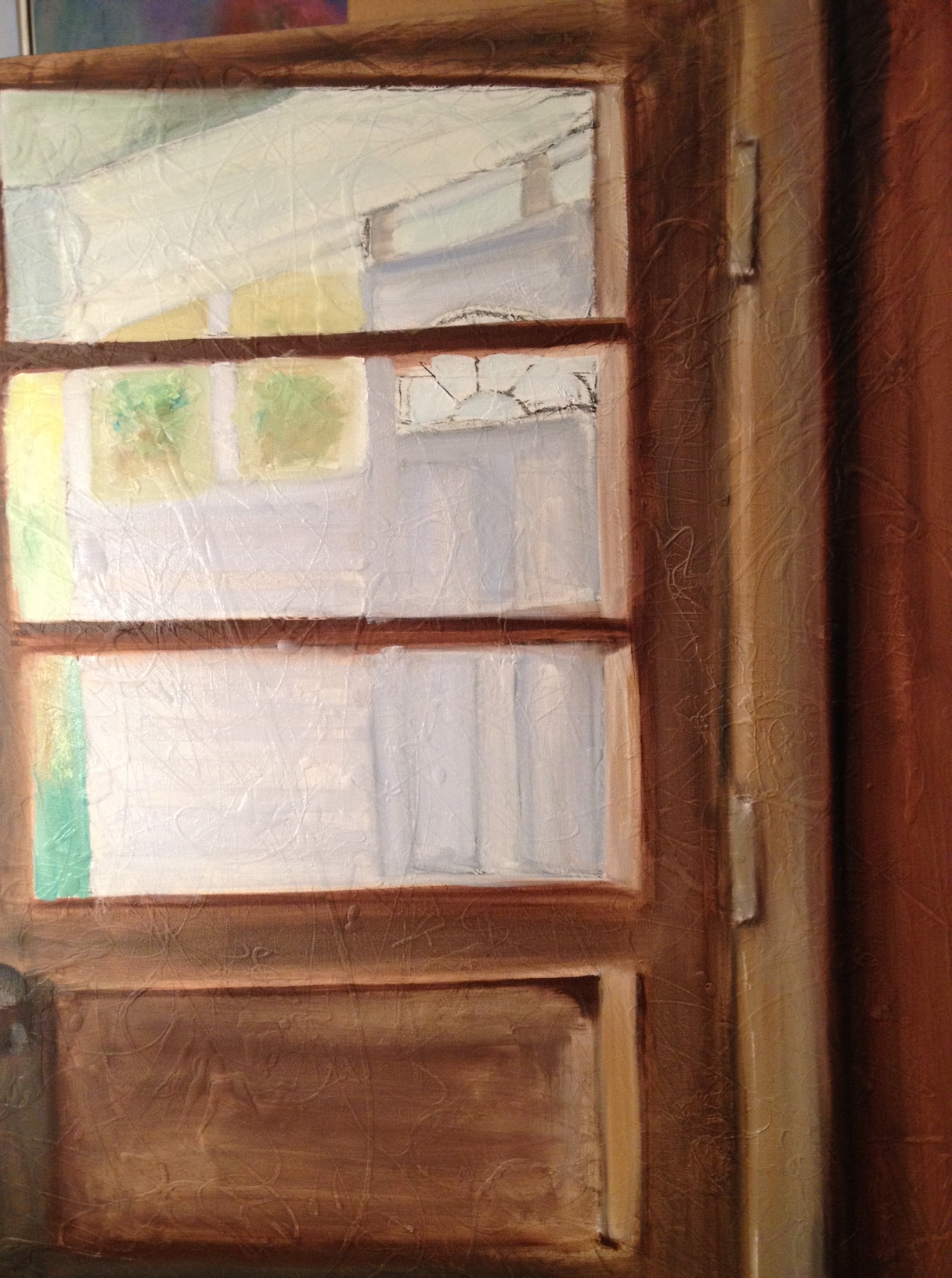
…and refining our knowledge, getting to what is really real.

I’ve had jobs that have kept me in the comfortable veil of illusion.  My personal “misery for happiness” illusion was thinking that I would get the golden ticket when I was a Mom of a toddler and a second grader, commuting 2 hours a day. When I was laid off from this job, I found a part-time (but really full-time) job helping a church build a mission into a free-standing non-profit organization serving vulnerable children with after school arts programming.  At the time, taking the Project Create job seemed self-indulgent.  Even though I was securing funding, developing the board, writing the 501(c)3 paperwork, hiring artists, keeping track of supply inventory and schlepping children all over town in a church van, I felt that I was hiding from the “real” world, licking my wounds.  But it was this job that was the realest of the real.  It allowed me to serve people who needed help.  It gave me the gift of hard physical labor.  I was able to develop or discover talents that would take to serve others.  Finally, this part-time job gave me time freedom that led to three other part-time jobs — one of which was with the Corcoran College of Art and Design, where I started to study and found more bliss in my own self-expression.

A yoga practice allows us to test, reframe and refine our knowledge each time we step on the mat and then asks that we take wisdom off the mat and into the world. The mat marks the path to our true selves that will not only give us, but also will allow us to reflect joy.

Thank you to all the wonderful friends at Iona Senior Services  as I celebrate five years of service this month.  Love the work — love you all!
Sangfroid and Phlegm

For my friends Laura, Cyndee, Barbara, Liz, Ann, Gretchen and all the parents I’ll meet at Freshman Orientation:

As my youngest is about to go 10 hours away to college, I have had to work almost minute-to-minute on a stiff upper lip.  My ancestors were fiery Scots, so the saying “Stay Calm and Carry On” doesn’t resonate.  The only thing that keeps me from collapsing on the floor in a puddle is remembering my sweet grandmother dabbing her eyes two weeks before we returned to Bangladesh every home leave.  Those tears were heavy on all of us.  I’m sure Nana felt cleansed, but my poor Mom was dripping in her mother’s emotion.  It wasn’t fair and I’m trying hard not to do it to my beautiful and talented daughter as she starts another exciting part of her own journey.

So yesterday in Todd’s class, when the intention of equanimity came to me, I folded it at heart center.  I worked on keeping a drishti, equalizing my breath, staying in touch with my edge, dropping to my knees when I needed  to return to balance.  I left practice feeling joyful.

Equanimity is balance of mind; composure that is maintained under stress.  Other synonyms are sangfroid, implying an icy control of the emotions, and phlegm, implying a composure that hides apathy.  It is a careful balance, isn’t it?  To maintain composure but not to lose the compassion that makes us human.  The definition of equanimity carries with it a sense of a habit of mind, not a personality tic or flaw.

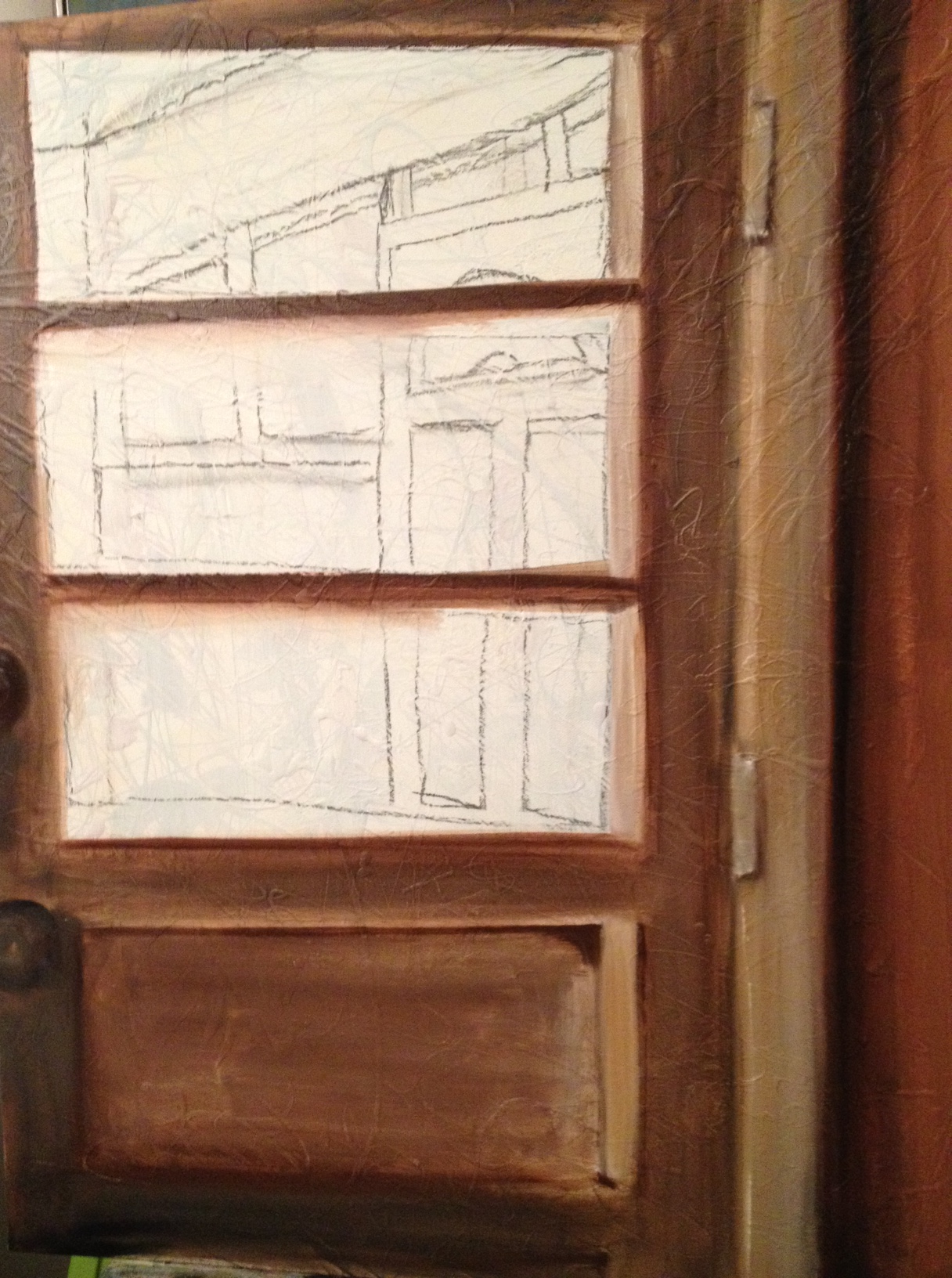
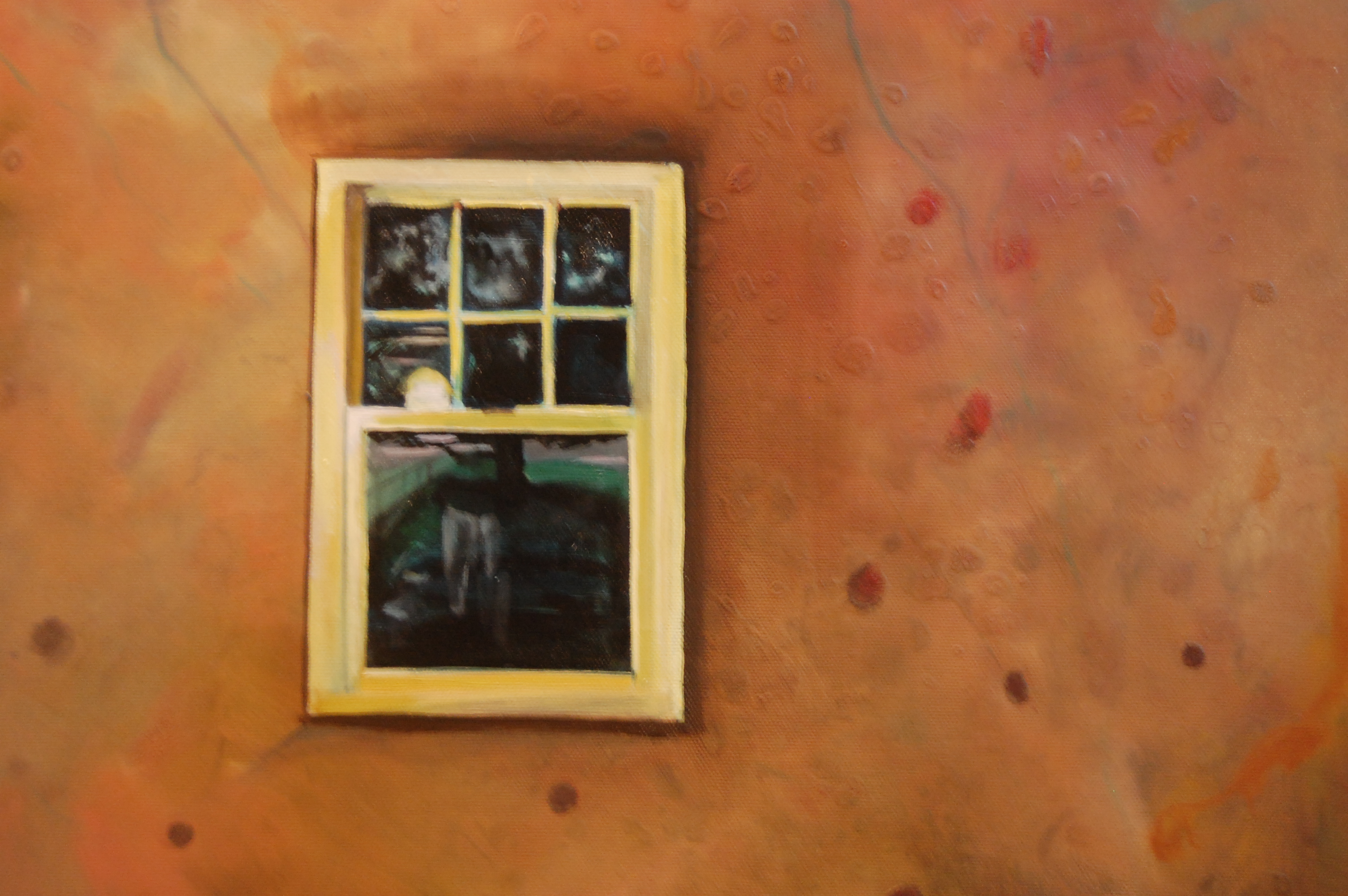
Yoga practice reminds us physically of balance, brushing away the thoughts that clutter a mind and make balance impossible.  Skin and bones are tools to reflection and perception, habits of mind and a habit of compassion for all, including ourselves. (This must be why this image came to me as I was recycling canvases.  The blobs of dried paint reminded me of flaws on skin and then the skin called for a…window? My concious mind didn’t know what my emotional body wanted me to understand.)

This week, as we enter another transition in our lives, one that seems less joyful than welcoming these beautiful children into our lives 18 years ago,Thich Nhat Hanh’s words will help us retain equanimity:

Life is filled with suffering, but it is also filled with many wonders, like the blue sky, the sunshine, the eyes of a baby.  To suffer is not enough.  We must also be in touch with the wonders of life.  They are within us and all around us, everywhere, anytime.

On Being Precious or Being Precise

The Renwick Gallery has an amazing new exhibition of 40 artists under 40 years old who are changing the face of art and craft.  The work exhibited there is transformative for anyone who is interested in creativity, inspiration and the artistic process.  I marvelled at the concepts they played with in their work and level of precision and craft that each artist has achieved in his or her own piece.  See a slide show of their work here.

One of the most important lessons for me to learn and relearn as a recovering creative has been to be honest about being precious and being precise about my work.  I had a wonderful painting teacher at the Corcoran named Tom Xenakis who would stand behind me in a painting class and say (in a very unjudgemental way):  “You are being precious.” He didn’t mean cute or funny.  He meant that I was being fastidious and affected in my work.  It is a challenge about the practice of art.  Tom’s lesson has stayed with me, although it usually doesn’t come to me the moment I need it, before I have painted a canvas into a muddy mess.  Or when I look at something I’ve worked very hard on but it won’t sing.  There’s just paint, no heart.

Like all good art teachers, Tom taught working the entire canvas, leaving something and returning to it, trusting the process of making art.  In other words — get the hell out of your own way.  Let it flow.  Stop thinking so much.   Look, focus, see and paint.

The practice of mindfulness — of being in the moment and getting yourself out of the way — is important to painting, to yoga practice, to life.  Precision happens in mindful moments.  It is when we really see the shape of an eye — it isn’t shaped like an almond, the pupil isn’t really round, the iris catches the light here and darkens there.  In asana practice, precision happens when we can turn off the noise in our minds to tune into the sensations of our bodies, allowing us to take flight into bakasana or come up into our first headstand.  Indeed, mindfulness allows us to be precise with the people we love.  It allows us  look into their eyes and be present, to empathize, to listen and to love.

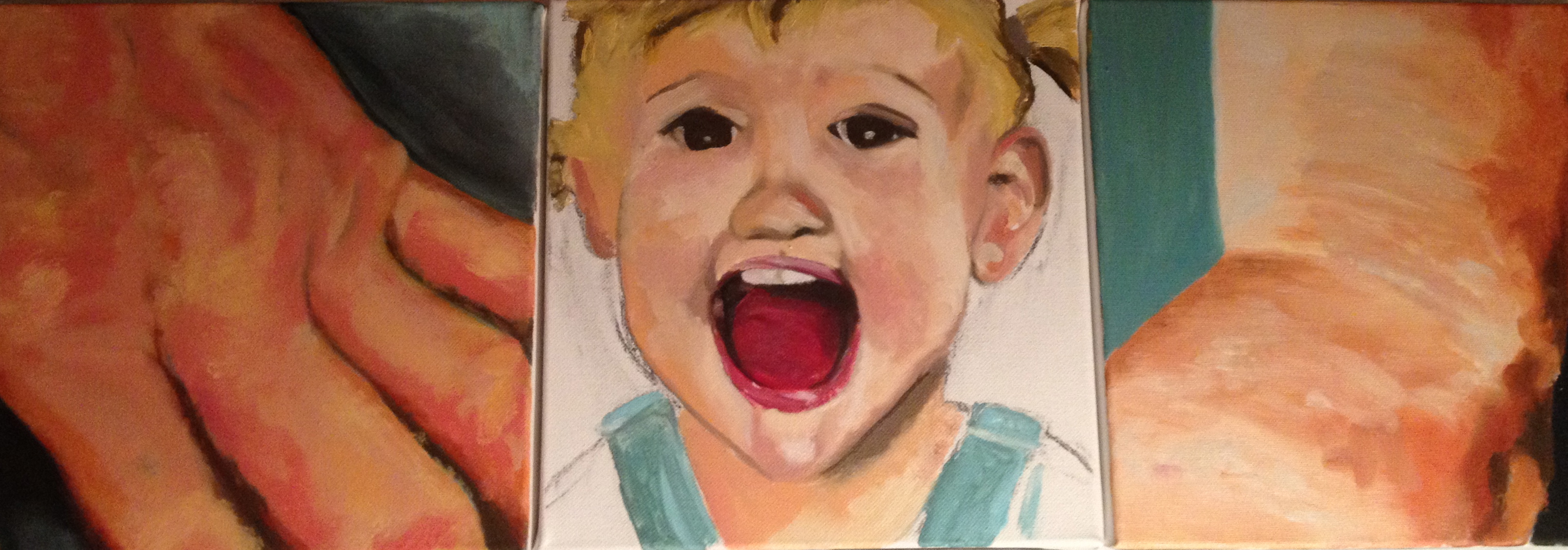
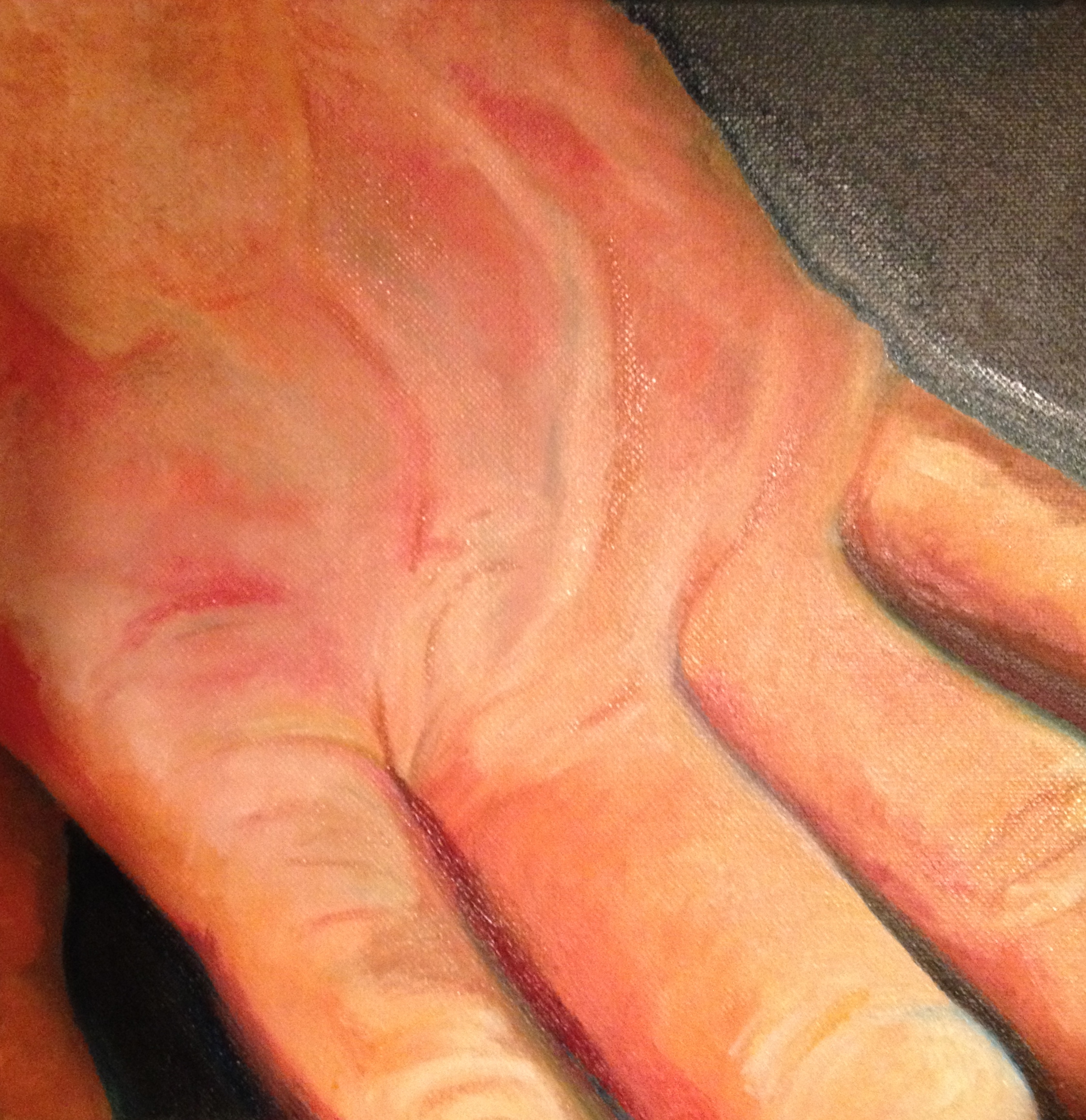
In Re-Entry I posted the painting of my husband’s hand.  I’ve added to the canvas a portrait of my daughter and the crook of his elbow, where she used to swing from as a toddler.  It is still unfinished, but I’m happy with it because I enjoyed every moment of the painting process.  I stopped being precious and just let the emotions carry me through.

Again I’ve learned the truth to the  Zen paradigm:  Stop thinking and talking about it and there is nothing that you will not be able to know.

Re Entry

I was whining about re-entry into regular life after a wonderful week of blissful nothingness.  No news.  No worries about work, or eating well or exercising, or morning journaling.  Heaven.

Then I heard the news that a local yoga teacher and his partner had been viciously attacked on Saturday night.  Police are investigating it as a hate crime.  His re-entry to his professional life will be tough with his injuries, but thanks to the yoga community, he will have some money to pay for medical bills —  I hope all the money he needs to pay his medical bills.  You’ll have to try hard NOT to find a charity yoga class set up in his honor this month and next in Washington, DC.  This Sunday there are several charity classes at Tranquil Space (www.tranquilspace.com).  Read about what happened, and where to make donations to cover Michael’s many medical expenses here:  http://www.huffingtonpost.com/2012/07/25/michael-hall-yoga-instructor-benefit_n_1699807.html.

The painting I started before I left on vacation has taken on new significance in the wake of this violence.  My original inspiration was my husband — I had been thinking about what a wonderful father he is to our kids, and now that our youngest is about to leave for college, about how good he was at being a parent to them when they were very young.  I’m currently working on another canvas of the crook of his elbow, where they curled up when they were infants, and from where they swung when they were older.

This terrible incident has me thinking about yoga teachers and their hands. Thanks to my wonderful teachers and their hands, I’ve learned about the art, the science and the heart of yoga.  I’m sure Michael is known and loved and respected because of this innate ability to guide people along a path of loving kindness. May he be healthy and whole very soon.